
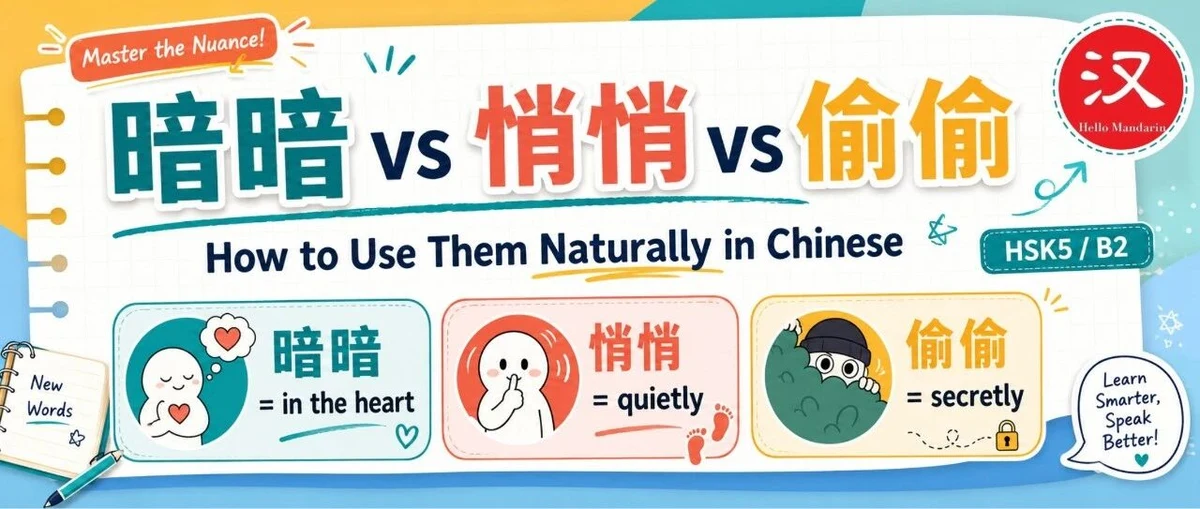
Grammar Focus: Similar Chinese Adverbs
Many Chinese learners translate 暗暗, 悄悄, and 偷偷 as “secretly.”
They are similar, but they are not exactly the same.
The key difference is:
暗暗 = secretly in one’s heart / without showing one’s feelings
悄悄 = quietly / without making noise or attracting attention
偷偷 = secretly / without letting others know, often because you do not want to be discovered
Let’s look at them one by one. 🌿
1. 暗暗(àn’àn)
Secretly in one’s heart / silently inside
暗暗 is often used for feelings, thoughts, decisions, or attitudes that are not shown openly.
It usually describes something happening inside someone’s heart or mind.
Common phrases with 暗暗:
暗暗喜欢
to secretly like someone
暗暗下决心
to silently make up one’s mind
暗暗观察
to observe secretly
暗暗佩服
to secretly admire someone
Examples
他暗暗喜欢她很多年了。
He has secretly liked her for many years.
我暗暗下定决心,一定要学好中文。
I silently made up my mind to learn Chinese well.
老师没有说出来,但他暗暗为学生感到高兴。
The teacher did not say it out loud, but he was secretly happy for the student.
Note
暗暗 is usually not used for quiet physical movement.
For example:
❌ 他暗暗走进房间。
This sounds unnatural.
✅ 他悄悄地走进房间。
He quietly walked into the room.

2. 悄悄(qiāoqiāo)
Quietly / without attracting attention
悄悄 focuses on being quiet or not obvious.
It is often used when someone moves, speaks, enters, leaves, or does something carefully without disturbing others.
Common phrases with 悄悄:
悄悄走开
to quietly walk away
悄悄进来
to quietly come in
悄悄告诉你
to tell you quietly
悄悄看一眼
to take a quiet look
Examples
孩子睡着了,妈妈悄悄地关上门。
The child fell asleep, and the mother quietly closed the door.
他悄悄地走进教室,没有打扰别人。
He quietly walked into the classroom and did not disturb anyone.
我悄悄告诉你一个好消息。
I’ll quietly tell you some good news.

Note
悄悄 does not necessarily mean someone is doing something wrong.
It mainly means the action is quiet, careful, or not easy to notice.
3. 偷偷(tōutōu)
Secretly / without being discovered
偷偷 focuses on hiding an action from others.
Sometimes the action may be against rules, not allowed, or something the speaker does not want others to know.
However, 偷偷 is not always negative. It can also be used for surprises.
Common phrases with 偷偷:
偷偷看手机
to secretly check one’s phone
偷偷出去
to secretly go out
偷偷吃零食
to secretly eat snacks
偷偷买礼物
to secretly buy a gift
Examples
他上课的时候偷偷看手机。
He secretly checked his phone during class.
她偷偷买了一份礼物,想给妈妈一个惊喜。
She secretly bought a gift and wanted to surprise her mother.
孩子偷偷吃了两块巧克力。
The child secretly ate two pieces of chocolate.

Note
偷偷 often gives the feeling that the person does not want others to know.
That is the biggest difference between 偷偷 and 悄悄.
4. Quick Comparison
暗暗
Focus: inner feelings, thoughts, or decisions
Meaning: secretly in one’s heart
Best used with: feelings, decisions, admiration, observation
Example:
他暗暗喜欢她。
Tā àn’àn xǐhuān tā.
He secretly likes her.
悄悄
Focus: quietness and low visibility
Meaning: quietly, without attracting attention
Best used with: moving, speaking, entering, leaving
Example:
她悄悄地离开了。
Tā qiāoqiāo de líkāi le.
She quietly left.
偷偷
Focus: hiding an action from others
Meaning: secretly, without being discovered
Best used with: hidden actions, private actions, rule-breaking actions, or surprises
Example:
他偷偷看手机。
Tā tōutōu kàn shǒujī.
He secretly checked his phone.

5. Can We Change Them?
Sometimes yes, but the meaning changes.
Example 1
他悄悄地走进房间。
Tā qiāoqiāo de zǒu jìn fángjiān.
He quietly walked into the room.
→ The focus is: he made little or no noise.
他偷偷走进房间。
Tā tōutōu zǒu jìn fángjiān.
He secretly walked into the room.
→ The focus is: he did not want others to know.
Example 2
我暗暗喜欢他。
Wǒ àn’àn xǐhuān tā.
I secretly like him.
→ This sounds like a feeling hidden in the heart.
我偷偷喜欢他。
Wǒ tōutōu xǐhuān tā.
I secretly like him.
→ This is understandable, but it sounds more casual and more focused on hiding the feeling from others.
For feelings, 暗暗 is usually more natural and slightly more formal.

6. Mini Practice ✍️
Choose the best word: 暗暗 / 悄悄 / 偷偷
-
孩子睡着了,爸爸____关上门。
The child fell asleep, and Dad quietly closed the door.
-
他上班的时候____玩游戏。
He secretly played games during work.
-
她没有说出来,只是____下定决心。
She did not say it out loud; she silently made up her mind.

Answers
-
悄悄
-
偷偷
-
暗暗
Final Tip 🌱
Use 暗暗 for hidden feelings, thoughts, or decisions.
Use 悄悄 when the action is quiet or not obvious.
Use 偷偷 when the action is hidden from other people.
A simple way to remember:
暗暗 = hidden in the heart
悄悄 = quiet in action
偷偷 = hidden from people ✨