When learning Chinese, many students first learn exact numbers:
三个人, 五本书, 两个小时.
But in real life, native speakers very often use approximate numbers instead of exact ones. We do not always want to sound overly precise. Sometimes we mean:
more than ten people
about three or four days
around a hundred students
a little more than one hour
This is where 概数 (gàishù) becomes very important. 😊
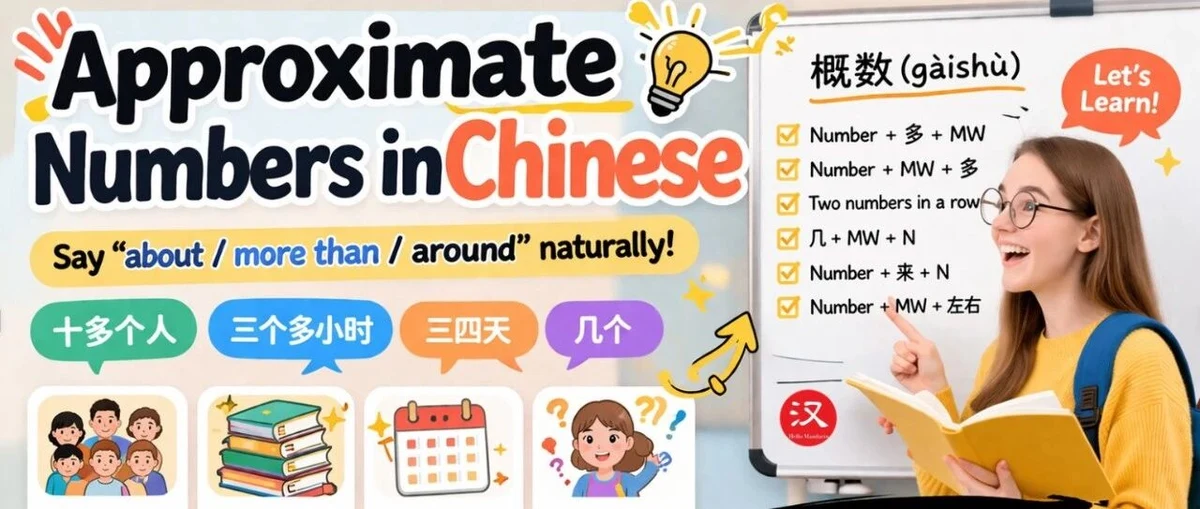
In this article, we will look at several very common ways to express approximate numbers in Chinese, explain the differences clearly, and show you how to use them naturally.
What Is 概数 (gàishù)?
概数 means an approximate number, not an exact one.
It is used when the speaker wants to give a general idea of quantity, amount, age, time, distance, or frequency, without stating an exact number.
For example:
他有二十多本书。
He has more than twenty books.
我等了他一个多小时。
I waited for him for a little over one hour.
他看起来十七八岁。
He looks about seventeen or eighteen years old.
1. Number + 多 + Measure Word / Noun
Meaning: more than that number
This pattern is used to show that the real number is a little more than the stated number.
Basic pattern:
Number + 多 + Measure Word + Noun
Common feature:
This pattern is most commonly used with round numbers, especially:
十, 二十, 三十, 一百, 一千 and so on.
Examples:
教室里有十多个学生。
There are more than ten students in the classroom.
我买了二十多本书。
I bought more than twenty books.
这个学校有一百多位老师。
This school has more than one hundred teachers.
他学了汉语三年多。
He has studied Chinese for more than three years.
Key point:
Here, 多 means “more than”, not simply “many.”
So:
十多个人 = more than ten people
一百多块钱 = more than one hundred yuan

2. Number + Measure Word + 多
Meaning: a little more than that amount
This is another very common pattern, but it is slightly different from the previous one.
Basic pattern:
Number + Measure Word + 多 + Noun
or
Number + Measure Word + 多
This pattern often appears when the number is smaller, more specific, or not a round tens number.
Examples:
我昨天睡了三个多小时。
I slept for a little more than three hours yesterday.
他来了一个多月了。
He has been here for a little more than one month.
这条路有五公里多。
This road is a little over five kilometers long.
这个孩子才两岁多。
This child is only a little over two years old.
Difference from Pattern 1:
Compare these:
十多个人 = more than ten people
三个多小时 = a little more than three hours
Both express “more than,” but the position of 多 changes depending on the structure and the kind of number used.
A useful way to remember:
If the number is a round number like 10, 20, 100, Chinese often uses:
十多 / 二十多 / 一百多
If the number is a more specific amount, Chinese often uses:
三个多 / 五天多 / 两岁多

3. Using Two Sequential Numbers
Meaning: about / around
Chinese often uses two adjacent numbers together to express approximation. This is very natural in spoken Chinese.
Basic pattern:
Number + Number
Usually the two numbers are next to each other, such as:
一二
两三
三四
五六
七八
十七八
Examples:
我想去北京玩两三天。
I want to go to Beijing for about two or three days.
他买了三四件衣服。
He bought about three or four pieces of clothing.
教室里坐着七八个人。
There are about seven or eight people sitting in the classroom.
她看起来十七八岁。
She looks about seventeen or eighteen years old.

Key point:
This pattern does not mean exactly both numbers.
It means approximately in that range.
So:
三四天 ≠ exactly 3 days and 4 days
It means about 3 or 4 days
4. Using 几 (jǐ)
Meaning: a few / several
几 is one of the most useful words for approximate number in Chinese.
Basic pattern:
几 + Measure Word + Noun
It usually refers to a small indefinite number, often less than ten.
Examples:
我有几个问题想问你。
I have a few questions to ask you.
他学了汉语几年了。
He has studied Chinese for several years.
桌子上有几本汉语书。
There are a few Chinese books on the table.
我们学校来了几位外国老师。
Several foreign teachers came to our school.
Important note:
In questions, 几 asks for an exact small number:
你有几个苹果?
How many apples do you have?
But in statements, it can mean a few / several, depending on context.
5. Using 来 (lái)
Meaning: around / about / approximately
Your original explanation here needs a small correction.
来 is indeed used to express an approximate number, but the most common structure is:
Basic pattern:
Number + 来 + Measure Word + Noun
It means the number is around that amount, usually close to it.
Examples:
教室里有十来个学生。
There are around ten students in the classroom.
他等了我半个来小时。
He waited for me for about half an hour.
这个村子有一百来户人家。
This village has around one hundred households.
来了二十来个人。
About twenty people came.

Key point:
来 often gives a feeling of “around that number”, while 多 often emphasizes “more than that number.”
Compare:
二十多个人 = more than twenty people
二十来个人 = around twenty people
This difference is subtle, but important.
6. Another Very Useful Pattern: 左右 (zuǒyòu)
Meaning: about / around
To make the article more complete, this pattern should definitely be included, because it is extremely common in both spoken and written Chinese.
Basic pattern:
Number + Measure Word + 左右
Examples:
我每天学习汉语两个小时左右。
I study Chinese for about two hours every day.
这个箱子有二十公斤左右。
This box weighs about twenty kilograms.
他大概七点左右到。
He will arrive at around seven o’clock.
Key point:
左右 is very neutral and very common.
It is often easier for learners to use than some of the more nuanced approximate-number patterns.
7. What Is the Difference Between 多, 来, and 左右?
This is where many learners get confused, so let’s make it very clear.
多
Usually means: more than the stated number
二十多个人
more than twenty people
三个多小时
a little more than three hours
来
Usually means: around / approximately
二十来个人
around twenty people
十来本书
about ten books
左右
Usually means: about / around, and is very neutral
二十个人左右
about twenty people
两个小时左右
about two hours
Quick comparison:
我们班有二十多个人。
Our class has more than twenty people.
我们班有二十来个人。
Our class has around twenty people.
我们班有二十个人左右。
Our class has about twenty people.
8. Common Mistakes Learners Make ⚠️
Mistake 1: Putting 多 in the wrong place
✅ 十多个人
✅ 三个多小时
❌ 三多个人
❌ 十个多人
You need to learn the structure as a fixed pattern.
Mistake 2: Confusing 多 with 来
✅ 二十多个人 = more than twenty
✅ 二十来个人 = around twenty
These are similar, but not identical.
Mistake 3: Using 几 for large numbers
几 usually refers to a small approximate number.
✅ 几个人
✅ 几本书
✅ 几年
For larger numbers, Chinese usually uses other patterns:
✅ 十多个人
✅ 一百来人
✅ 两百左右
9. Practical Example Sentences 🌟
Here are some extra examples you can directly learn from:
我家离学校有十来分钟的路。
My home is about ten minutes away from the school.
他一个月能看七八本书。
He can read about seven or eight books in one month.
我有几个中国朋友。
I have a few Chinese friends.
这个包一百多块钱。
This bag costs more than one hundred yuan.
他学汉语学了五个多月。
He has studied Chinese for a little over five months.
今天来了三十多个学生。
More than thirty students came today.
10. A Simple Summary
When you want to express approximate numbers in Chinese, these are the most useful patterns:
十多个人 → more than ten people
三个多小时 → a little more than three hours
三四天 → about three or four days
几个问题 → a few questions
十来本书 → about ten books
二十分钟左右 → about twenty minutes
If you can master these patterns, your Chinese will sound much more natural and much closer to how native speakers really talk. ✨
Final Tip
Do not try to translate approximate numbers word-for-word from English.
Instead, remember the Chinese patterns as chunks:
十多 + noun
三个多 + noun
三四 + measure word
几 + measure word + noun
十来 + measure word + noun
number + measure word + 左右
Once you get used to these patterns, expressing quantities in Chinese becomes much easier.