
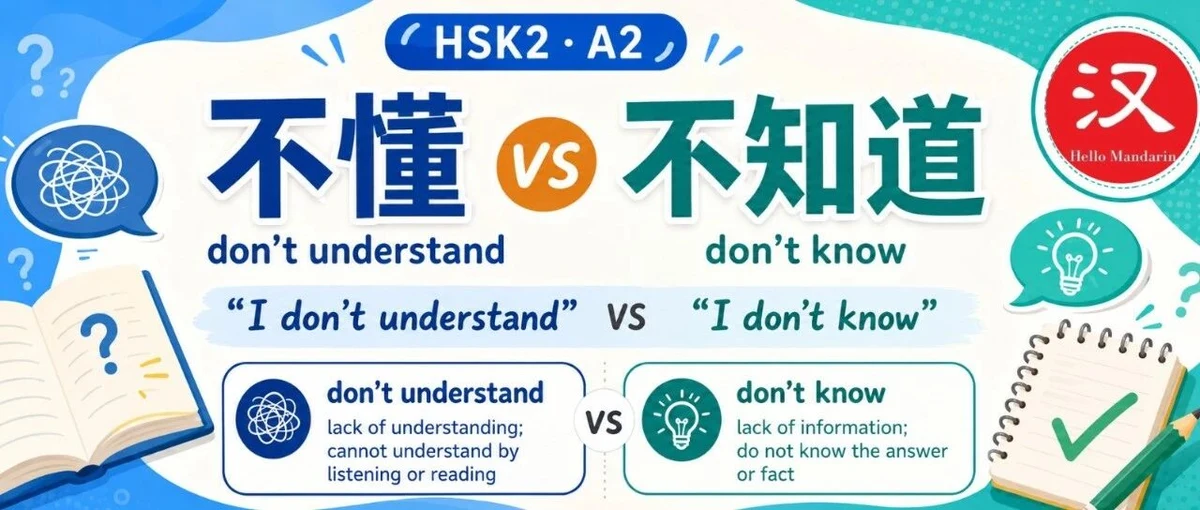
Many Chinese learners often mix up 不懂 and 不知道 because both can sometimes be translated as “I don’t know” in English.
But in Chinese, they are not the same.
The key difference is simple:
不懂 = I don’t understand.
不知道 = I don’t know.
Let’s learn the difference clearly. 😊
1. What does 不懂 mean?
不懂 means not understand.
It is used when you do not understand the meaning, logic, grammar, skill, or content of something.
Structure:
Subject + 不懂 + noun / content
Examples:
我不懂这个词。
I don’t understand this word.
我不懂这句话的意思。
I don’t understand the meaning of this sentence.
他不懂中文。
He doesn’t understand Chinese.
我不懂这个语法。
I don’t understand this grammar point.
Here, the problem is not missing information.
The problem is understanding.

2. What does 不知道 mean?
不知道 means not know.
It is used when you do not know a fact, answer, name, place, time, reason, or situation.
Structure:
Subject + 不知道 + question word / sentence
Examples:
我不知道他的名字。
I don’t know his name.
我不知道今天几号。
I don’t know what date it is today.
她不知道老师在哪里。
She doesn’t know where the teacher is.
我不知道怎么回答这个问题。
I don’t know how to answer this question.
Here, the problem is missing information or an answer.

3. The easiest way to remember
Use 不懂 when you want to say:
“I don’t understand it.”
Use 不知道 when you want to say:
“I don’t know the answer / information.”
Compare these two sentences:
我不懂这个问题。
I don’t understand this question.
The question is confusing. I don’t understand what it means.
我不知道这个问题的答案。
I don’t know the answer to this question.
I understand the question, but I don’t know the answer.
This difference is very important. 🌿
4. Common mistakes
Mistake 1
❌ 我不懂他的名字。
Wǒ bù dǒng tā de míngzi.
This sounds unnatural because a name is information, not something you “understand.”
Better:
✅ 我不知道他的名字。
I don’t know his name.
Mistake 2
❌ 我不知道这个语法。
Wǒ bù zhīdào zhège yǔfǎ.
This sentence is possible in some contexts, but for learners, it often sounds less natural if you mean “I don’t understand this grammar.”
Better:
✅ 我不懂这个语法。
I don’t understand this grammar point.
Mistake 3
❌ 我不懂他在哪里。
Wǒ bù dǒng tā zài nǎlǐ.
This is not natural if you simply mean you do not know his location.
Better:
✅ 我不知道他在哪里。
I don’t know where he is.

5. Sometimes both are possible, but the meaning changes
Some sentences can use both 不懂 and 不知道, but the meaning is different.
Example 1
我不知道他为什么生气。
I don’t know why he is angry.
This means: I do not know the reason.
我不懂他为什么生气。
I don’t understand why he is angry.
This means: I know the situation, but I feel his reaction is hard to understand.
Example 2
我不知道怎么做。
I don’t know how to do it.
This means: I need the method or instructions.
我不懂怎么做。
I don’t understand how to do it.
This means: someone may have explained it, but I still do not understand the method clearly.

6. More useful examples
我不懂你说的意思。
I don’t understand what you mean.
我不知道他说了什么。
I don’t know what he said.
这个词我不懂。
I don’t understand this word.
这个词我不知道怎么用。
I don’t know how to use this word.
我不懂汉字。
I don’t understand Chinese characters.
我不知道这个汉字怎么读。
I don’t know how to read this Chinese character.

7. Quick summary
不懂 focuses on understanding.
Use it with:
meaning
grammar
language
content
logic
skills
Examples:
我不懂中文。
I don’t understand Chinese.
我不懂这个句子。
I don’t understand this sentence.
不知道 focuses on information.
Use it with:
name
time
place
answer
reason
method
Examples:
我不知道他的电话号码。
I don’t know his phone number.
我不知道怎么去那里。
I don’t know how to get there.
Final tip
When you want to say “I don’t understand,” use 不懂.
When you want to say “I don’t know,” use 不知道.
A simple sentence to remember:
我不懂这个问题,但是我知道答案。
I don’t understand this question, but I know the answer.
Sounds strange, right?
That is exactly why 不懂 and 不知道 are different. 😊