
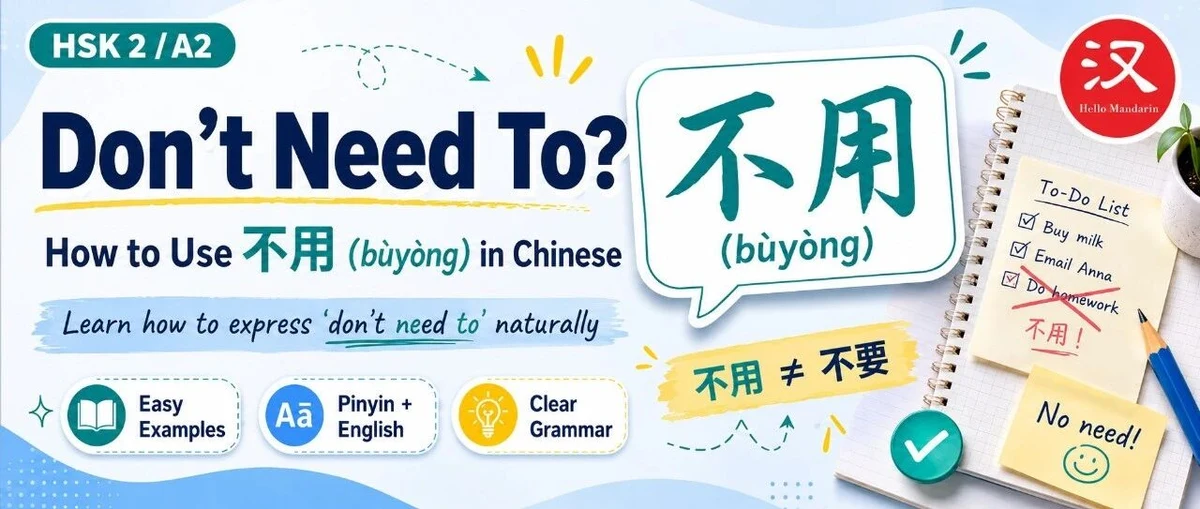
HSK 2 / A2 Grammar Guide
In Chinese, 不用 is a very common word.
It means “don’t need to,” “do not have to,” or “no need to.”
You can use 不用 when you want to say that something is not necessary.
🌿 Important pronunciation note:
The dictionary form is bù yòng, but in natural speech, because 用 yòng is a fourth-tone word, 不 is usually pronounced as bú.
So we usually read it as:
不用
don’t need to / no need to
1. Basic meaning of 不用
不用 means something is not necessary.
It does not mean “must not.”
It simply means:
You don’t need to do it.
It is not necessary.
You don’t have to do it.
Structure
Subject + 不用 + verb / verb phrase
Examples
你不用来。
You don’t need to come.
我今天不用上班。
I don’t need to work today.
我们明天不用上课。
We don’t have class tomorrow.
你不用买票。
You don’t need to buy a ticket.

2. 不用 + verb — don’t need to do something
This is the most common structure.
Use 不用 before a verb to say that an action is not necessary.
Examples
你不用等我。
You don’t need to wait for me.
你不用告诉他。
You don’t need to tell him.
我们不用坐地铁,可以走路去。
We don’t need to take the subway. We can walk there.
你不用写这个字。
You don’t need to write this character.

3. 不用 + adjective / feeling word
In daily Chinese, 不用 is also often used before some words that describe feelings or reactions.
The most common ones are:
不用急
don’t need to hurry / no need to rush
不用担心
don’t need to worry
不用害怕
don’t need to be afraid
不用客气
no need to be polite / you’re welcome
Examples
你不用急,还有时间。
No need to rush. There is still time.
你不用担心,我可以帮你。
Don’t worry. I can help you.
你不用害怕,这个问题不难。
Don’t be afraid. This question is not difficult.
谢谢你!
Thank you!
不用客气。
You’re welcome. / No need to be so polite.
4. 不用了 — no need anymore / no thanks
不用了 is very useful in spoken Chinese.
It often means:
No need anymore.
That’s okay.
No thanks.
You can use it when someone offers help, food, a drink, or something else, but you want to politely refuse.
Examples
A: 你要水吗?
Do you want some water?
B: 不用了,谢谢。
No thanks, thank you.
A: 我帮你拿吧。
Let me help you carry it.
B: 不用了,我自己可以。
No need, I can do it myself.
A: 要不要我再说一遍?
Do you want me to say it again?
B: 不用了,我明白了。
No need, I understand now.

5. 不用 vs 不要
Many Chinese learners confuse 不用 and 不要.
They are different.
不用 = don’t need to
It means something is not necessary.
你不用去。
You don’t need to go.
This means going is not necessary.
But if you want to go, maybe it is still okay.
不要 = don’t / should not
It is often used to stop someone from doing something.
你不要去。
Don’t go.
This sounds stronger.
It means the speaker does not want you to go, or thinks you should not go.
Compare
你不用说。
You don’t need to say it.
你不要说。
Don’t say it.
The first sentence means it is not necessary.
The second sentence means please do not say it.

6. 不用 vs 不需要
不用 and 不需要 can both mean “don’t need to.”
But they are not always the same.
不用 is more common in daily speech
你不用来了。
You don’t need to come anymore.
This sounds natural and conversational.
不需要 is a little more formal
这个表格不需要填写。
This form does not need to be filled in.
This sounds more formal or written.
Small difference
不需要 can be followed by a noun more easily.
我不需要你的帮助。
I don’t need your help.
With 不用, we usually use a verb phrase:
你不用帮我。
You don’t need to help me.
7. Common daily expressions with 不用
Here are some very useful expressions.
不用谢
You’re welcome. / No need to thank me.
不用客气
You’re welcome. / No need to be polite.
不用担心
Don’t worry.
不用急
No need to rush.
不用麻烦了
No need to trouble yourself.
不用再说了
No need to say more.

8. Common mistakes
Mistake 1: Using 不用 when you mean “don’t”
Don’t say:
你不用在这里抽烟。
This sounds like: You don’t need to smoke here.
If you want to say “Don’t smoke here,” say:
你不要在这里抽烟。
Don’t smoke here.
Or more naturally:
这里不能抽烟。
Smoking is not allowed here.
Mistake 2: Translating “no need” too directly
In English, we often say “No need.”
In Chinese, we often say:
不用了
No need. / No thanks.
Example:
A: 我帮你叫车吧。
Let me call a car for you.
B: 不用了,我已经叫了。
No need, I already called one.
Mistake 3: Forgetting the tone change of 不
The word 不 is usually fourth tone: bù.
But before another fourth-tone word, it changes to second tone in pronunciation.
So:
不用 is pronounced bú yòng.
不要 is pronounced bú yào.
不是 is pronounced bú shì.
This tone change makes your Chinese sound more natural. 🎧
9. Quick Review
Use 不用 when something is not necessary.
Basic structure:
Subject + 不用 + verb / verb phrase
Examples:
你不用来。
You don’t need to come.
你不用担心。
You don’t need to worry.
不用了,谢谢。
No thanks, thank you.
Remember:
不用 = don’t need to / no need to
不要 = don’t / should not
不需要 = do not need, usually a little more formal
Learning 不用 will help you sound more natural and polite in daily Chinese. 😊