
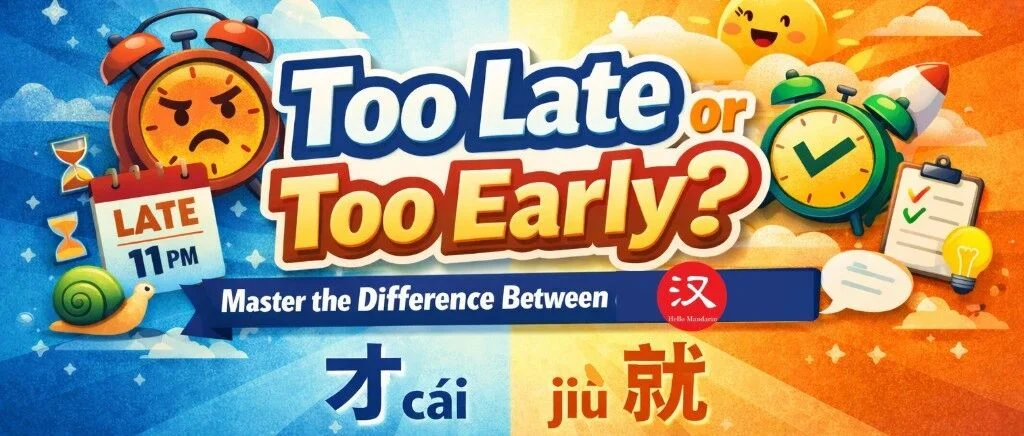
When learning Chinese, two small words often confuse learners: 才 (cái) and 就 (jiù). They are both adverbs and usually appear before the verb, but they often express opposite attitudes about time, quantity, or expectation.
Understanding the difference between 才 and 就 will help your Chinese sound more natural and precise. Let’s break it down step by step. 🚀
1️⃣ The Core Difference Between 才 and 就
The most important idea to remember is their opposite perspective.
才 (cái) → emphasizes lateness, delay, or “only then”
就 (jiù) → emphasizes earliness, quickness, or “already”
In simple terms:
才 = later than expected
就 = earlier than expected
Examples:
他晚上十一点才到家。
He didn’t get home until 11 PM.
他晚上八点就到家了。
He already got home at 8 PM.

Same structure — but completely different feeling.
2️⃣ Using 才 (cái) to Express “Later Than Expected”
One of the most common uses of 才 is to show that something happened later than expected.
Structure:
Subject + Time Expression + 才 + Verb
Examples:
我等了一个小时她才来。
I waited for an hour and only then did she come.
他晚上十一点才到家。
He didn’t arrive home until 11 PM.
我花了三个小时才写完作业。
It took three hours before I finally finished the homework.

📌 The speaker usually feels something was slow, delayed, or took a long time.
3️⃣ 才 (cái) Meaning “Only” (Small Amount)
才 can also mean “only”, emphasizing that the number is smaller than expected.
Structure:
Subject + 才 + Verb + Number / Quantity
Examples:
我今天才走了三百米。
I only walked 300 meters today.
他才二十岁。
He is only 20 years old.
我早上才喝了一杯咖啡。
I only drank one cup of coffee this morning.

Here, 才 emphasizes that the amount is small.
4️⃣ 才 (cái) Meaning “It’s Only…”
When 才 appears with a time expression, it can mean “it’s only…”, suggesting that it’s still early.
Structure:
现在 / 这时候 + 才 + Time
Examples:
现在才八点。
It’s only 8 o’clock now.
才早上六点,我想再睡一会儿。
It’s only 6 AM, I want to sleep a little longer.
5️⃣ Using 就 (jiù) to Express “Earlier Than Expected”
In contrast, 就 emphasizes that something happened earlier or sooner than expected.
Structure:
Subject + Time + 就 + Verb
Examples:
她十五岁就不上学了。
She stopped going to school as early as fifteen.
我晚上八点就睡觉了。
I went to bed as early as 8 PM.
他六点就起床了。
He already got up at 6.
📌 就 often implies speed, efficiency, or earliness.
6️⃣ 就 (jiù) Meaning “Only” (Usually Showing Surprise)
就 can also mean “only”, but the feeling is different from 才.
就 often shows surprise, complaint, or dissatisfaction.
Examples:
我们有这么多人,你就买了一瓶饮料?
We have so many people, and you only bought one bottle of drink?
你每天就睡五个小时吗?
You only sleep five hours every day?
我今天就吃了一个包子。
I only ate one baozi today.
Here, the speaker usually feels the amount is surprisingly small.
7️⃣ Using 才 and 就 Together
Interestingly, 才 and 就 can appear in the same sentence to show a strong contrast between two actions.
Structure:
Subject + 才 + Verb Phrase + 就 + Verb Phrase
This structure often implies “just now… and already…” or “as soon as…”.
Examples:
电影才开始,你就不想看了?
The movie just started, and you already don’t want to watch it?
你才来就要走?
You just arrived and already want to leave?
我才坐下,他就开始问问题。
I had just sat down when he started asking questions.

8️⃣ Quick Summary
Remember these key ideas:
才 (cái)
• emphasizes lateness or delay
• can mean “only” (small amount)
• often shows something happened later than expected
就 (jiù)
• emphasizes earliness or quickness
• can mean “only” with surprise or complaint
• often shows something happened earlier than expected
📌 A simple trick to remember:
才 → late / delayed
就 → early / quick
⭐ Mastering these two words will make your Chinese much more natural and expressive.
Keep practicing — and you’ll start noticing 才 and 就 everywhere in real conversations!
加油!💪