
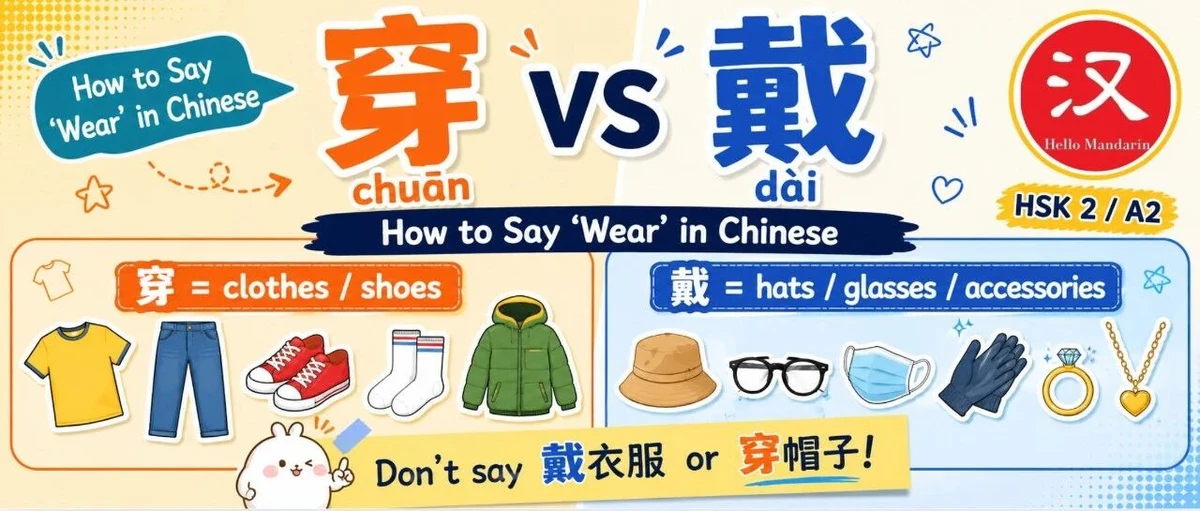
Don’t Say “穿帽子” or “戴衣服”!
In English, we often use one word: wear.
But in Chinese, “wear” is usually divided into two common verbs:
穿 chuān = to wear clothes / shoes
戴 dài = to wear accessories or things placed on the body
They are both verbs, but they are used with different kinds of objects.
1. Use 穿 chuān for clothes and shoes 👕👖👟
Use 穿 when something is worn on the body like clothing.
Common words with 穿:
穿衣服 chuān yīfu = wear clothes
穿衬衫 chuān chènshān = wear a shirt
穿裙子 chuān qúnzi = wear a skirt
穿裤子 chuān kùzi = wear pants
穿鞋 chuān xié = wear shoes
穿袜子 chuān wàzi = wear socks
Examples
我今天穿了一件蓝色的衬衫。
I wore a blue shirt today.
她喜欢穿裙子。
She likes wearing skirts.
下雨了,你要穿雨衣。
It’s raining. You should wear a raincoat.
他没穿鞋就出门了。
He went out without wearing shoes.
2. Use 戴 dài for accessories and things placed on the body 🧢👓💍
Use 戴 when something is put on the head, face, hands, neck, or another part of the body.
Common words with 戴:
戴帽子 dài màozi = wear a hat
戴眼镜 dài yǎnjìng = wear glasses
戴口罩 dài kǒuzhào = wear a mask
戴手套 dài shǒutào = wear gloves
戴戒指 dài jièzhi = wear a ring
戴项链 dài xiàngliàn = wear a necklace
Examples
他每天都戴眼镜。
He wears glasses every day.
天气很冷,她戴了手套。
The weather is cold, so she wore gloves.
请戴口罩。
Please wear a mask.
她戴着一条漂亮的项链。
She is wearing a beautiful necklace.
3. The easiest rule to remember 🎯
Use 穿 for things like clothes, shoes, and socks.
Use 戴 for things like hats, glasses, masks, gloves, rings, and necklaces.
A simple memory trick:
穿 = clothes and shoes
戴 = accessories and things added to the body
4. Common mistakes ❌✅
❌ 我戴衣服。
This sounds wrong.
✅ 我穿衣服。
I wear clothes.
❌ 他穿帽子。
This sounds wrong.
✅ 他戴帽子。
He wears a hat.
❌ 她穿眼镜。
This sounds wrong.
✅ 她戴眼镜。
She wears glasses.
5. 穿着 and 戴着: “be wearing” 👀
If you want to say someone is wearing something, you can use:
穿着 chuānzhe = be wearing clothes/shoes
戴着 dàizhe = be wearing accessories
Examples
他穿着黑色的外套。
He is wearing a black coat.
她戴着红色的帽子。
She is wearing a red hat.
那个老师戴着眼镜。
That teacher is wearing glasses.

Quick Review ✅
穿 chuān is used with clothes, shoes, and socks.
For example: 穿衣服, 穿裤子, 穿鞋, 穿袜子.
戴 dài is used with hats, glasses, masks, gloves, rings, and jewelry.
For example: 戴帽子, 戴眼镜, 戴口罩, 戴戒指.
So next time you want to say “wear” in Chinese, don’t translate directly from English.
First ask yourself:
Is it clothing or shoes? Use 穿.
Is it an accessory or something placed on the body? Use 戴. 😊