
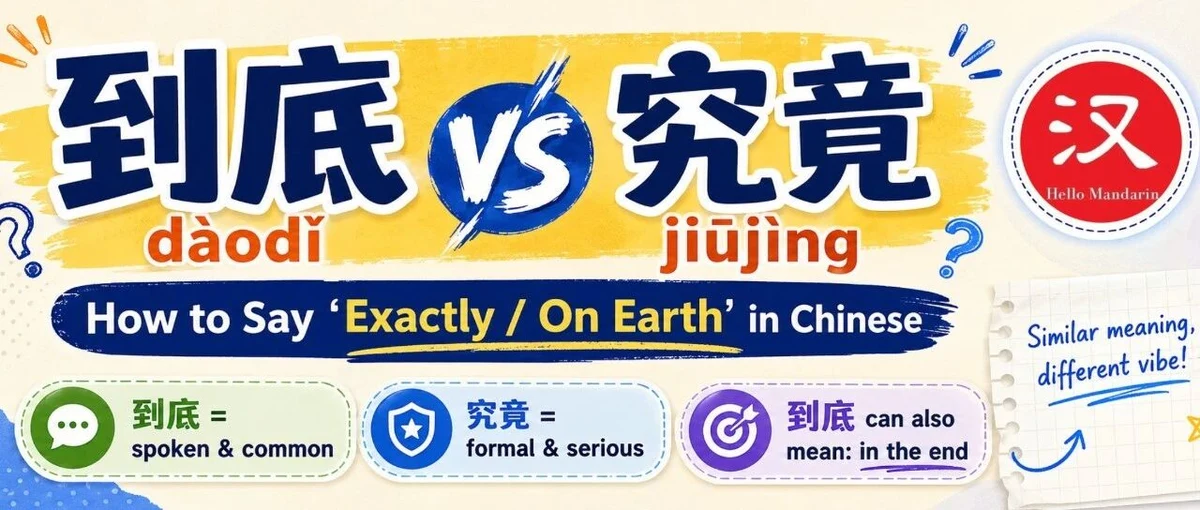
When Chinese learners see 到底 and 究竟, they often translate both as:
exactly / on earth / in the end
They are very close in meaning, but they are not always used in the same feeling.
A simple way to remember:
到底 = more common in spoken Chinese, stronger emotion
究竟 = more formal, more serious, often used in writing or careful questions
Let’s look at them clearly. 😊
1. 到底 and 究竟 both emphasize a question
Both 到底 and 究竟 can make a question stronger.
They often mean:
“exactly?”
“on earth?”
“what really…?”
Structure
Subject + 到底 / 究竟 + question word + …?
Examples
你到底想说什么?
What exactly do you want to say?
他究竟为什么离开公司?
Why exactly did he leave the company?
这件事到底是谁做的?
Who on earth did this?
问题究竟出在哪里?
Where exactly is the problem?
2. 到底 is more common in daily speaking
In everyday Chinese, 到底 is used much more often than 究竟.
It can sound curious, confused, impatient, or emotional, depending on the tone.
Examples
你到底来不来?
Are you coming or not?
你到底怎么了?
What on earth happened to you?
他到底去哪儿了?
Where on earth did he go?

This kind of 到底 is very natural in spoken Chinese.
But be careful: if your tone is too strong, 到底 may sound impatient or a little angry.
3. 究竟 sounds more formal and serious
究竟 is also used to emphasize a question, but it sounds more formal, calm, or analytical.
You can often see it in news, articles, reports, academic writing, or serious discussions.
Examples
这个政策究竟会带来什么影响?
What impact exactly will this policy bring?
事情的真相究竟是什么?
What exactly is the truth of the matter?
我们究竟应该怎么解决这个问题?
How exactly should we solve this problem?
Compared with 到底, 究竟 feels more careful and formal.
4. 到底 can also mean “in the end / after all”
This is an important difference.
到底 can be used in statements, not only questions.
In this use, it often means:
in the end
after all
finally
Examples
问题到底还是解决了。
In the end, the problem was solved after all.
他到底还是来了。
In the end, he still came.
她到底是个有经验的老师。
After all, she is an experienced teacher.
In these sentences, 到底 does not mean “on earth.”
It means “after all / in the end.”
This usage is very common.
5. Can 究竟 also mean “in the end”?
Sometimes 究竟 can also relate to the final result or truth, but in modern daily Chinese, it is much more common in questions.
For learners, the safest rule is:
Use 究竟 mainly in questions.
Use 到底 in both questions and some statements.
Natural
他到底还是同意了。
In the end, he agreed.
Less common in daily speech
他究竟还是同意了。
This is not the most natural everyday expression.
So, when you want to say “in the end / after all”, choose 到底.
6. Word order: where should 到底 / 究竟 go?
Most of the time, they come after the subject and before the main question part.
Common structure
Subject + 到底 / 究竟 + question word + verb…?
Examples
你到底想去哪儿?
Where exactly do you want to go?
他究竟在想什么?
What exactly is he thinking?
Sometimes 到底 or 究竟 can appear before the subject for stronger emphasis, but this is less basic.
Example
到底谁说的?
Who exactly said that?
For most learners, the easiest pattern is:
Subject + 到底 / 究竟 + question word…?

7. Quick comparison
到底
More spoken, more emotional, very common in daily life.
It can be used in questions and statements.
究竟
More formal, more serious, often used in writing, news, reports, or careful questions.
It is mainly used in questions.
8. More useful examples
你到底要不要去?
Do you want to go or not?
你到底明不明白我的意思?
Do you actually understand what I mean or not?
这本书究竟讲了什么?
What exactly is this book about?
我们到底应该相信谁?
Who exactly should we trust?
这两个词究竟有什么区别?
What exactly is the difference between these two words?
他到底还是选择了留下。
In the end, he still chose to stay.

9. Common mistakes
Mistake 1
他究竟还是来了。
This sentence is not impossible, but it sounds unnatural in daily Chinese.
Better:
他到底还是来了。
In the end, he still came.
Mistake 2
你究竟来不来?
This is grammatically correct, but in daily conversation it may sound too formal or too serious.
More natural:
你到底来不来?
Are you coming or not?
Final Tip
Use 到底 when you speak in daily life.
Use 究竟 when you want your sentence to sound more formal, serious, or written.
The easiest rule:
到底 = daily spoken Chinese + stronger emotion
究竟 = formal Chinese + serious question
So if you are not sure which one to use, choose 到底 in normal conversation. 😊