
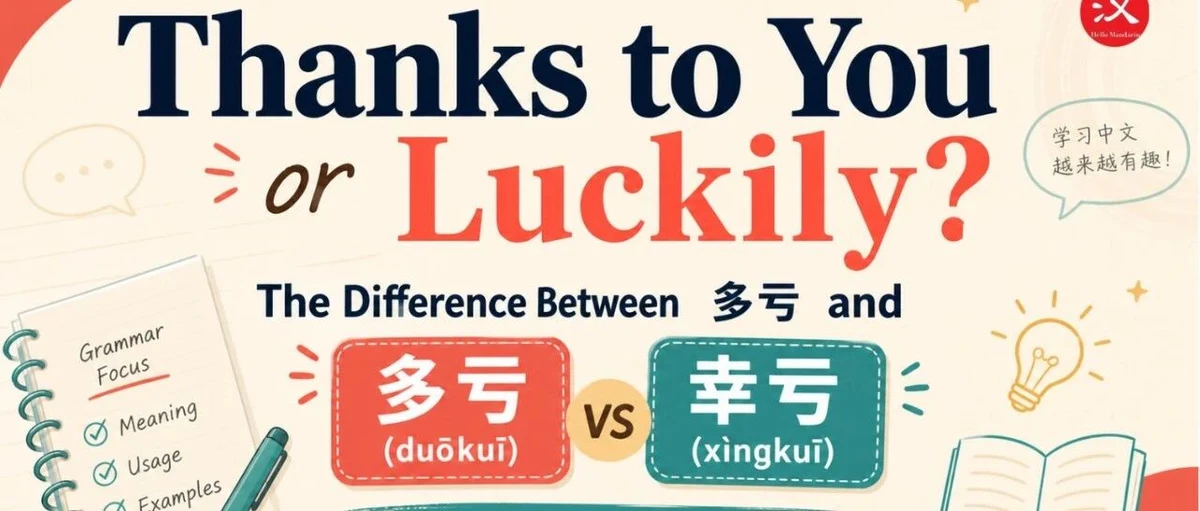
Many Chinese learners translate 多亏 and 幸亏 as “thanks to” or “luckily.”
They are similar because both are used when something bad almost happened, but in the end the result was good or not too bad. 🌿
However, they are not exactly the same.
The key difference is:
多亏 focuses more on “thanks to someone or something.”
幸亏 focuses more on “luckily / fortunately.”
In other words, 多亏 often gives credit to a person, action, help, or condition.
幸亏 simply emphasizes that the situation was lucky.
1. What does 多亏 mean?
多亏 (duōkuī) means thanks to, owing to, or it is a good thing that…
It is often used when someone or something helped prevent a bad result.
多亏 can be followed by:
多亏了 + noun / person / help
多亏 + clause
For example:
多亏了你,我才找到这个地方。
Thanks to you, I was able to find this place.
Here, 你 is the person who helped. The speaker feels grateful.
多亏老师的帮助,我通过了HSK考试。
Thanks to the teacher’s help, I passed the HSK exam.
Here, 多亏 gives credit to 老师的帮助.
多亏你提醒我,不然我就忘了。
Thanks to your reminder, otherwise I would have forgotten.
This sentence shows a very common pattern:
多亏……,不然 / 否则……
Thanks to…, otherwise…

2. What does 幸亏 mean?
幸亏 (xìngkuī) means luckily, fortunately, or it was lucky that…
It is usually used before a complete clause. It does not focus strongly on who should receive credit. Instead, it emphasizes that the result was fortunate.
For example:
幸亏我带了伞,不然就被雨淋湿了。
Luckily, I brought an umbrella; otherwise I would have got wet.
Here, the focus is not gratitude. The speaker is saying, “Good thing I brought an umbrella.”
幸亏他来得早,不然我们就赶不上火车了。
Luckily, he arrived early; otherwise we would not have caught the train.
幸亏今天不堵车,我们准时到了。
Luckily, there was no traffic today, so we arrived on time.
In these examples, 幸亏 mainly describes a lucky situation.

3. The main difference: gratitude vs luck
The easiest way to remember the difference is:
多亏 = thanks to someone / something
幸亏 = luckily / fortunately
Compare these two sentences:
多亏你帮我,我才完成了作业。
Thanks to your help, I finished my homework.
This sentence sounds grateful. The speaker is giving credit to 你.
幸亏你帮我,不然我完成不了作业。
Luckily, you helped me; otherwise I could not have finished my homework.
This sentence is also natural, but the feeling is slightly different. It emphasizes that the timing or situation was lucky.
So, when you want to say “I really benefited from your help,” 多亏 is often better.
When you want to say “Luckily this happened,” 幸亏 is often better.

4. Can 多亏 and 幸亏 both be used with 不然?
Yes. Both words are often used with 不然 or 否则, meaning “otherwise.”
多亏你来了,不然我不知道怎么办。
It’s a good thing you came; otherwise I wouldn’t know what to do.
幸亏你来了,不然我不知道怎么办。
Luckily you came, otherwise I would not know what to do.
Both sentences are correct.
The difference is only in feeling:
多亏你来了 sounds more like “Your coming helped me a lot.”
幸亏你来了 sounds more like “It was lucky that you came.”

5. Word class and grammar usage
多亏 is often used like a verb or preposition-like expression. It can directly introduce a helpful person, thing, action, or condition.
Common structures:
多亏了 + noun / person
多亏 + person / clause
多亏……,不然 / 否则……
Examples:
多亏了这本书,我终于明白了这个语法点。
Thanks to this book, I finally understood this grammar point.
多亏你解释得清楚,我听懂了。
Thanks to your clear explanation, I understood it.
幸亏 is usually an adverb. It is placed before a clause and describes the whole situation as lucky.
Common structures:
幸亏 + subject + verb phrase
幸亏……,不然 / 否则……
Examples:
幸亏我提前出门了,不然一定会迟到。
Luckily, I left early; otherwise I would definitely be late.
幸亏问题不严重,我们很快就解决了。
Luckily, the problem was not serious, and we solved it quickly.

6. A common mistake: 幸亏 cannot usually be followed by only a noun
Many learners want to say:
❌ 幸亏了你。
This sounds unnatural.
A better sentence is:
✅ 幸亏有你。
Luckily, you were there.
Or:
✅ 多亏了你。
Thanks to you.
So remember:
多亏了你 is natural.
幸亏有你 is natural.
But 幸亏了你 is not natural.

7. More useful examples
多亏朋友帮忙,我找到了新工作。
Thanks to my friend’s help, I found a new job.
幸亏面试不难,我没有太紧张。
Luckily, the interview was not difficult, so I was not too nervous.
多亏医生及时治疗,他很快恢复了。
Thanks to the doctor’s timely treatment, he recovered quickly.
幸亏我们发现得早,问题还不大。
Luckily, we found it early, so the problem was not too serious.
多亏你给我发消息,我才想起来今天有课。
Thanks to your message, I remembered that I had class today.
幸亏今天老师没有考试。
Luckily, the teacher did not give a test today.

8. Quick summary
Use 多亏 when you want to thank or give credit to someone or something.
多亏了你。
Thanks to you.
Use 幸亏 when you want to say something happened fortunately.
幸亏我没迟到。
Luckily, I was not late.
A simple way to remember:
多亏 = thanks to
幸亏 = luckily
Both words are very useful in real Chinese, especially when you want to talk about a bad result that almost happened — but luckily did not. 🌟