
Have you ever heard someone say:
反正我不去。
Anyway, I’m not going.
Or:
别担心,反正还有时间。
Don’t worry. We still have time anyway.
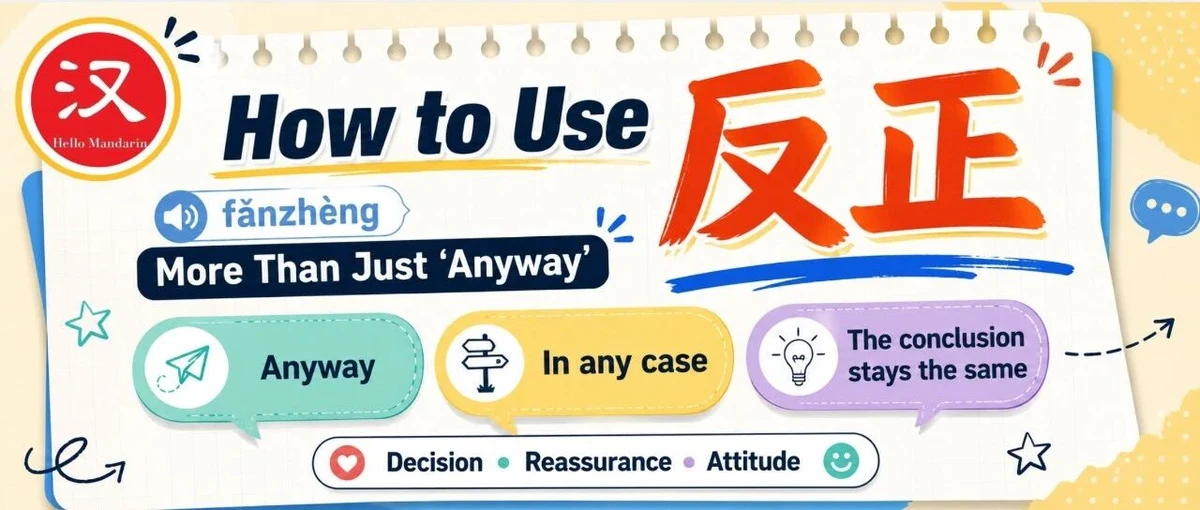
The word 反正 (fǎnzhèng) is very common in spoken Chinese.
Depending on the context, it can be translated as:
👉 anyway
👉 in any case
👉 either way
👉 regardless
👉 no matter what happens
But simply memorizing 反正 = anyway is not enough.
The core idea is:
The circumstances may change, but the speaker’s conclusion, decision, or attitude remains the same.
In simple words:
Other details do not change the final conclusion.
Let’s look at how 反正 is actually used in natural Chinese. 👇
1️⃣ The Basic Meaning: “Anyway” or “In Any Case”
The most common use of 反正 is to introduce a conclusion or decision that will not change.
📌 Common Structure
反正 + Clause
Example 1
反正我今天没事,我们慢慢聊吧。
I’m free today anyway, so let’s take our time and talk.
Example 2
你去不去都可以,反正我要去。
Whether you go or not is up to you. Anyway, I’m going.
Example 3
现在解释也没用了,反正事情已经发生了。
There is no point explaining it now. In any case, it has already happened.
💡 In these examples, the speaker believes that other possibilities or details will not change the main conclusion.
The feeling is often:
“Whatever happens, this fact or decision remains the same.”

2️⃣ Different Conditions, Same Conclusion
反正 is often used when different possibilities lead to the same result or do not affect the speaker’s decision.
It often appears with expressions such as:
不管……
no matter…
无论……
regardless of…
or:
V 不 V / A 还是 B
Example 1
不管明天下不下雨,反正我们都要出发。
Whether it rains tomorrow or not, we’re leaving anyway.
Example 2
无论别人怎么说,反正我相信他。
No matter what other people say, I believe him anyway.
Example 3
坐地铁还是坐公交都可以,反正我们不赶时间。
We can take the subway or the bus. Either way, we’re not in a hurry.
🔑 The logic is:
Condition A changes.
Condition B changes.
The final conclusion stays the same.
That is one of the most important meanings of 反正.

3️⃣ Using 反正 to Support a Decision or Suggestion 💡
A speaker may first make a suggestion or decision and then use 反正 to introduce a fact that supports it.
📌 Common Pattern
Decision / Suggestion,反正 + Supporting Situation
Example 1
我们打车吧,反正时间已经不早了。
Let’s take a taxi. It’s already getting late anyway.
Example 2
多买一点儿吧,反正以后也用得上。
Let’s buy a little more. We’ll be able to use it later anyway.
Example 3
今天休息一下吧,反正工作也做不完。
Let’s take a break today. We won’t be able to finish all the work anyway.
Here, the 反正-clause does more than give a neutral reason.
It presents a situation that the speaker treats as enough support for a decision, suggestion, or conclusion.
The feeling is:
“Since this situation is already the case, this decision makes sense.”

4️⃣ Using 反正 for Reassurance 😌
反正 is also commonly used to reassure someone.
The speaker introduces a fact that makes the situation feel less serious, less urgent, or easier to handle.
Example 1
别着急,反正我们还有时间。
Don’t worry. We still have time anyway.
Example 2
没关系,坐下一班车吧,反正我们不赶时间。
It’s okay. Let’s take the next bus. We’re not in a hurry anyway.
Example 3
你慢慢准备,反正会议下午才开始。
Take your time getting ready. The meeting doesn’t start until the afternoon anyway.
In this use, 反正 often creates a relaxed and reassuring tone.
The speaker is basically saying:
“It’s okay. This situation means we don’t need to worry.”
5️⃣ Using 反正 to Show Indifference or Resignation
Depending on the tone and context, 反正 can also express:
🔹 indifference
🔹 resignation
🔹 stubbornness
🔹 determination
In these situations, the speaker may sound like they have already made up their mind.
Example 1
随便你怎么想,反正我已经决定了。
Think whatever you want. Anyway, I’ve already made my decision.
Example 2
他来不来都无所谓,反正我们自己也能完成。
It doesn’t matter whether he comes or not. We can finish it ourselves anyway.
Example 3
迟到就迟到吧,反正我也赶不上了。
If I’m late, I’m late. I’m not going to make it anyway.
⚠️ Pay attention to tone.
Compare:
反正还有时间。
We still have time anyway.
This can sound reassuring.
But:
反正我不管。
Anyway, I don’t care. / Whatever, I’m not dealing with it.
This can sound impatient, unfriendly, or dismissive.
So, the meaning of 反正 is strongly influenced by the situation and the speaker’s tone.

6️⃣ 反正 with Rhetorical Questions 🤔
反正 can also appear before a rhetorical question.
However, 反正 itself is not a rhetorical-question marker.
Instead, it first introduces a situation that the speaker treats as fixed or already accepted. The rhetorical question then follows naturally.
Example 1
反正都来了,为什么不进去看看呢?
Since we’re here anyway, why not go inside and have a look?
Example 2
反正你也不想去,何必勉强自己呢?
You don’t want to go anyway, so why force yourself?
Example 3
反正明天是周末,晚一点儿睡有什么关系?
Tomorrow is the weekend anyway, so what’s wrong with going to bed a little later?
The logic is:
A situation is already true → so why not…?
This structure is often used to make a suggestion sound reasonable or obvious.

7️⃣ 反正 vs 既然: What’s the Difference?
反正 and 既然 (jìrán) can sometimes appear in similar situations, but they are not the same.
They focus on different things.
🔹 既然 (jìrán)
既然 means:
since
given that
It introduces a known fact or premise.
Example
既然你累了,就早点儿休息吧。
Since you’re tired, go to bed earlier.
The logic is:
You are tired → therefore, you should rest.
🔹 反正 (fǎnzhèng)
反正 often highlights the speaker’s attitude toward an already accepted situation.
Example
反正明天不用上班,今天晚一点儿睡吧。
We don’t have to work tomorrow anyway, so let’s stay up a little later tonight.
The feeling is:
“This is already the situation, so my decision makes sense.”
🧠 Easy Way to Remember
既然:
Since this is true, then…
反正:
This is true anyway, so…
They may overlap in some contexts, but they are not freely interchangeable.

8️⃣ Common Mistake: Don’t Use 反正 for Every “Because”
A common learner mistake is to use 反正 whenever English uses “because” or “since.”
However, 反正 is not simply another word for 因为.
Compare:
Neutral Cause and Effect
因为下雨了,所以比赛取消了。
The match was canceled because it rained.
This sentence gives an objective reason.
Speaker’s Decision or Attitude
反正下雨了,我们就别出去了。
It’s raining anyway, so let’s not go out.
Here, the speaker uses an existing situation to support a decision.
⚠️ Consider this sentence:
反正下雨了,所以比赛取消了。
Fǎnzhèng xiàyǔ le, suǒyǐ bǐsài qǔxiāo le.
This sentence is possible in a suitable context, but 反正 is usually not the best choice if the speaker simply wants to describe an objective cause-and-effect relationship.
For neutral explanations, 因为……所以…… is usually clearer.

🎯 Quick Summary
The key idea behind 反正 (fǎnzhèng) is:
Other conditions or possibilities do not change the final conclusion, decision, or attitude.
You can use 反正 to:
🔹 say “anyway” or “in any case”
🔹 show that different conditions lead to the same conclusion
🔹 support a decision or suggestion
🔹 reassure someone
🔹 express indifference or resignation
🔹 introduce a fixed situation before a rhetorical question
The easiest way to remember 反正:
Other details don’t really matter. This is the situation or conclusion anyway.
✏️ Mini Practice
Look at these two sentences:
A
因为明天不上班,所以我们今天可以晚一点儿睡。
Because we don’t have to work tomorrow, we can go to bed a little later tonight.
B
反正明天不上班,我们今天晚一点儿睡吧。
We don’t have to work tomorrow anyway, so let’s stay up a little later tonight.
Both sentences are correct, but the feeling is different.
Sentence A gives a neutral reason.
Sentence B sounds more conversational and reflects the speaker’s attitude and decision.
That difference is exactly what makes 反正 such a useful word in natural spoken Chinese. 😄