
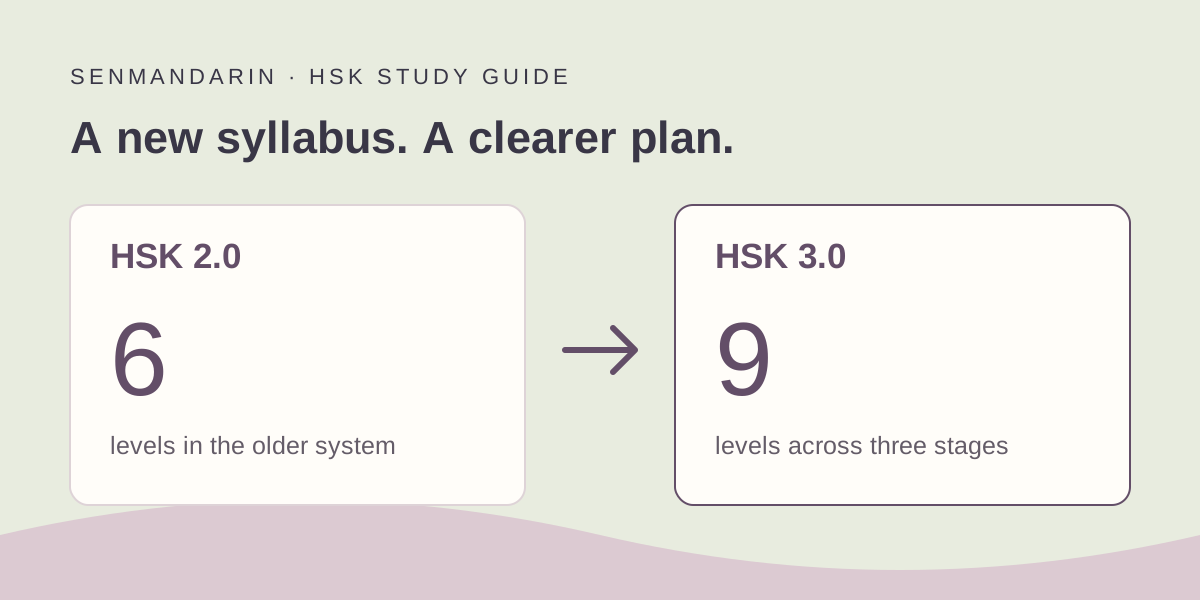
A book labelled “HSK 4” does not tell you everything you need to know. You also need to know which version of the exam it prepares you for.
The new HSK changes the vocabulary assigned to each level and gives learners a broader syllabus of communication tasks, topics, characters and grammar. Your existing Chinese still matters. The practical job is to identify the gaps between what you know and the version you will actually take.
The main differences at a glance
| Area | HSK 2.0 | New HSK examination syllabus |
|---|---|---|
| Level structure | Six levels, HSK 1–6 | Nine levels: elementary 1–3, intermediate 4–6 and advanced 7–9 |
| Vocabulary | Older six-level word lists | Revised lists with different level assignments and 11,000 entries across all bands |
| Speaking | HSKK is a separate speaking examination; some registration arrangements bundle it with HSK | Level-specific speaking papers are available for levels 3–6; check the rules for your sitting |
| Characters | Reading and writing requirements depend on the level and test format | Separate recognition and handwriting lists make the learning targets more explicit |
| Study materials | Use the older syllabus and matching practice papers | Use the new examination syllabus and matching sample papers |
On smaller screens, swipe sideways to compare the columns.
The level numbers are not a conversion table. Passing old HSK 4 does not automatically demonstrate that every new HSK 4 requirement has been met.
How the vocabulary totals compare
These are cumulative totals, including entries introduced at lower levels. The advanced 7–9 band shares one combined list.
| Level | HSK 2.0 | New HSK examination syllabus |
|---|---|---|
| 1 | 150 | 300 |
| 2 | 300 | 500 |
| 3 | 600 | 1,000 |
| 4 | 1,200 | 2,000 |
| 5 | 2,500 | 3,600 |
| 6 | 5,000 or more | 5,400 |
| 7–9 combined | No corresponding band within the old six-level system | 11,000 |
On smaller screens, swipe sideways to compare the columns.
For example, new HSK 2 introduces 200 additional entries after the 300 at level 1. It does not require a separate set of 500 new words on top of level 1.
Do not calculate your personal gap by subtracting the two totals. A revised list can add, remove or move entries between levels. Compare the actual words you know, together with their meanings and uses.
You may also see “HSK 3.0” used for the 2021 proficiency standards, whose early-level vocabulary targets differ from the later examination syllabus. Before buying a book or downloading a list, check the edition and the syllabus it follows. SenMandarin’s new vocabulary collection follows the 2025 examination syllabus.
Reading characters and writing them are different targets
Recognizing a character in a sentence is not the same as producing it from memory.
The new syllabus lists 100 handwriting characters shared by levels 1 and 2. Its cumulative handwriting targets then reach 250 at level 3, 400 at level 4, 550 at level 5, 700 at level 6 and 1,200 across the advanced band. These are syllabus learning targets, not a claim that a level 1 examination contains a separate 100-character handwriting task.
Keep recognition practice, handwriting practice and exam tasks distinct. If you are taking a computer-based examination, practise the input method and task types you will use. For handwriting practice, use the character studio to review stroke order and make a worksheet.
What changes about speaking?
The older HSKK uses three speaking levels: beginner, intermediate and advanced. The new sample-paper collection includes separate speaking papers for HSK 3, 4, 5 and 6.
For the 2026 trial sittings, candidates at levels 3–6 were required to register for the matching speaking test. That trial rule should not be presented as proof that every later sitting in every country uses identical booking requirements. A separate booking process also does not, by itself, establish whether a university or programme requires both results.
Before registering, check the written test, the speaking test and the requirements of the institution receiving your results. Ask the test centre if the booking options are unclear.
For study, build speaking into your routine: describe a picture, summarize something you heard, explain a choice and answer a follow-up question. Record yourself so that you can notice unclear pronunciation, unfinished sentences and missing connections between ideas.
Which version should you prepare for in 2026?
CTI announced 13 December 2026 as the official launch date for HSK 3.0. That announcement is different from assuming that every local test centre has the same transition timetable.
For example, the Japanese HSK organizer’s notice dated 2 October 2026 states that its regular 2026 examinations will continue under HSK 2.0, with arrangements for 2027 still being finalized. The January and September 2026 trial examinations are another distinct case.
Check your country, test centre, date, level and version on the official registration website. If you have already registered, use the details of that booking rather than changing your study plan solely because an online guide gives a global date.
A practical plan for moving to the new syllabus
- Confirm your examination. Save the exact version, level and format shown by your test centre.
- Audit your vocabulary. Use the new HSK vocabulary browser to identify unfamiliar entries. Learn a word’s reading, meaning, word class and a useful sentence together.
- Review grammar by version. The new grammar index follows the new syllabus; the old six-level collection remains available for earlier materials.
- Practise communication. Turn vocabulary into short explanations, requests, descriptions and conversations rather than treating a word count as the whole course.
- Use matching practice papers. Work on the task types and timing for your own examination, then revise the weaknesses your practice reveals.
Your old materials can still help with grammar and everyday language. Use them alongside a checked syllabus, rather than expecting the old level label to cover every new requirement.
If you would like help choosing a starting point, contact Jason on WeChat. A short discussion of your goals and current Chinese is more useful than choosing a course from the level number alone.