
Hey Chinese learners!
Have you ever read a long Chinese sentence and accidentally missed one small detail?
Or have you ever known something was important, but still did not pay enough attention to it?
In English, words like ignore, overlook, neglect, and disregard can sometimes feel similar.
But in Chinese, 忽略 and 忽视 are not exactly the same.
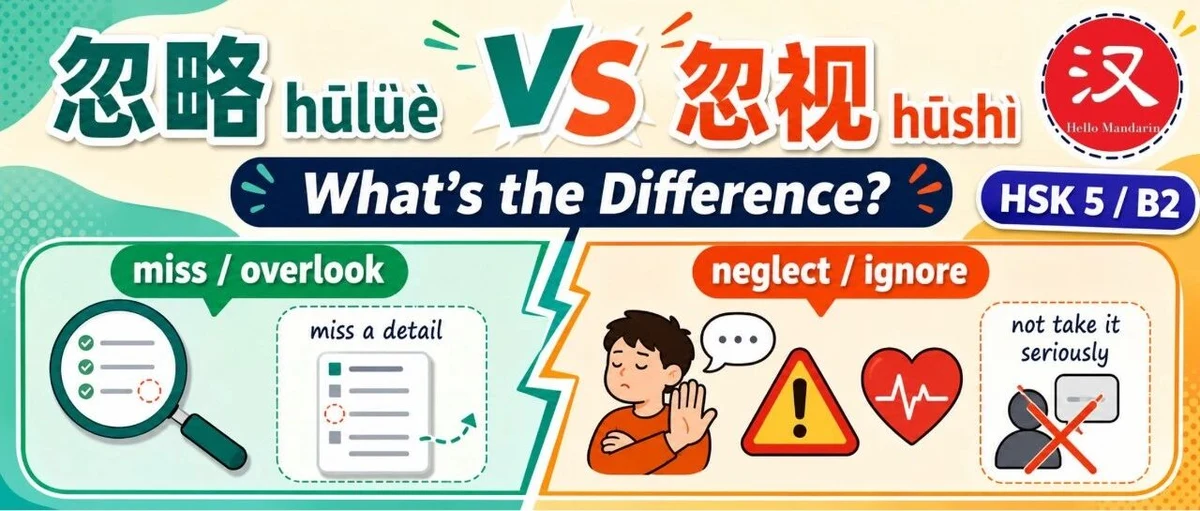
忽略 focuses more on missing, overlooking, or leaving something out.
忽视 focuses more on not paying enough attention to something important.
Let’s look at the difference clearly. 🎯
1. 忽略 hūlüè — to overlook / leave out / miss something
忽略 means to miss something, overlook something, or leave something out.
It is often used when someone does not notice a detail, forgets to consider a factor, or decides that something is too small to count.
The key idea is:
Something was not included, noticed, or considered.
Common phrases:
忽略细节
to overlook details
忽略问题
to overlook a problem
忽略一个因素
to overlook a factor
忽略不计
to ignore something because it is too small to count / negligible
Examples
对不起,我在看合同的时候忽略了这个细节。
Sorry, I overlooked this detail when I was reading the contract.
做计划时,我们不能忽略天气这个因素。
When making a plan, we cannot overlook the weather as a factor.
这个问题太小了,完全可以忽略。
This problem is so small that it can be completely ignored.
这部分费用很少,可以忽略不计。
This part of the cost is very small and can be considered negligible.
2. 忽视 hūshì — to neglect / not take seriously / fail to value
忽视 means to not pay enough attention to something that should be important.
It is often used with serious or important things, such as health, safety, education, risks, problems, feelings, or someone’s opinion.
The key idea is:
Something important was not valued or taken seriously enough.
It does not always mean someone ignored it on purpose.
Sometimes it means they simply did not give it enough attention.
Common phrases:
忽视健康
to neglect one’s health
忽视安全
to disregard safety / not take safety seriously
忽视风险
to underestimate or ignore risks
忽视孩子的感受
to neglect a child’s feelings
被忽视的感觉
the feeling of being ignored / neglected
Examples
工作再忙,你也不能忽视身体健康。
No matter how busy you are with work, you cannot neglect your health.
很多父母容易忽视孩子的感受。
Many parents easily neglect their children’s feelings.
在团队里,他的意见总是被大家忽视。
In the team, his opinions are always ignored by everyone.
我们不能忽视这个问题的严重性。
We cannot ignore the seriousness of this problem.
3. The easiest way to remember
Here is a simple way to understand the difference:
忽略 hūlüè
= You missed it, left it out, or did not include it.
Focus: missing a detail or factor
忽视 hūshì
= You did not pay enough attention to something important.
Focus: not taking something seriously enough
For example:
忽略一个细节
to overlook a detail
忽视一个问题
to fail to take a problem seriously
忽略天气因素
to overlook the weather factor
忽视安全问题
to neglect safety issues
4. A useful comparison: 安全规则
Look at these two sentences:
他忽略了安全规则中的一个细节。
He overlooked one detail in the safety rules.
Here, 忽略 means he missed a detail.
他忽视了安全规则。
He did not take the safety rules seriously.
Here, 忽视 sounds more serious. It means he failed to value the rules properly.
Quick Quiz 🧠
Which word is better?
-
我太粗心了,____了一个重要细节。
I was too careless and overlooked an important detail.
-
年轻人不应该____身体健康。
Young people should not neglect their health.
-
这个数字太小了,可以____不计。
This number is too small and can be considered negligible.
Answers:
-
忽略
-
忽视
-
忽略
Quick Summary
忽略 = overlook / miss / leave out
Use it when a detail, factor, problem, or small amount is not noticed or not included.
忽视 = neglect / not take seriously
Use it when something important is not given enough attention or value.
So remember:
忽略 is about missing something.
忽视 is about not valuing something enough.