
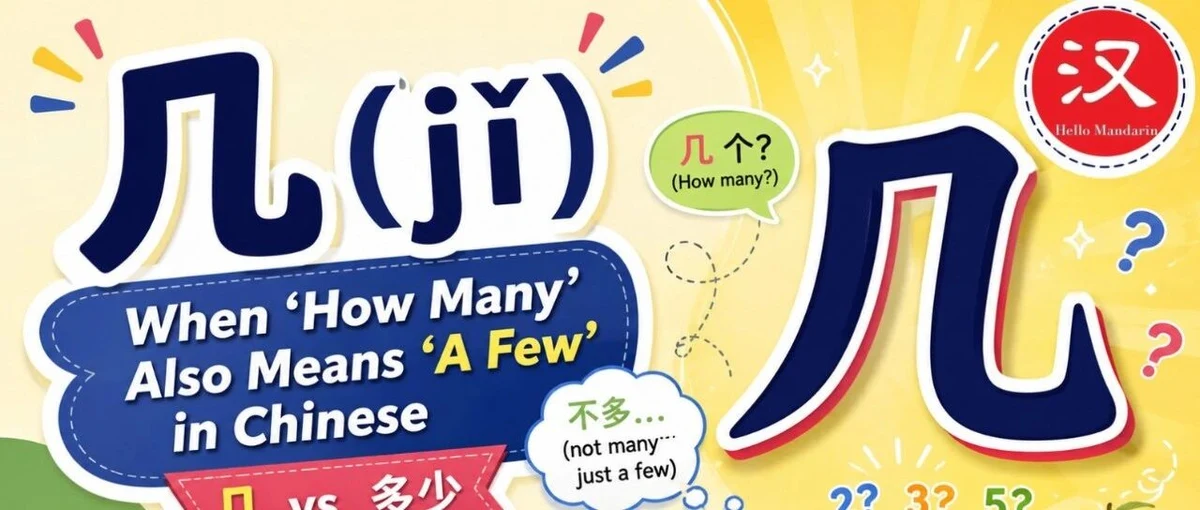
Many Chinese learners first learn 几 (jǐ) as a question word meaning “how many?”
For example:
你有几个朋友?
How many friends do you have?
But in real Chinese, 几 is not only used for questions. It can also refer to an uncertain small number — usually something like a few / several / some.
This use is very common in daily Chinese. Let’s look at it clearly. 😊
1. Basic Meaning of 几
几 (jǐ) can mean two things:
1. “How many?”
It is used to ask about a number.
2. “A few / several / some”
It is used when the exact number is not important or not clear.
So, the meaning of 几 depends on the sentence.
Compare:
你买了几个苹果?
How many apples did you buy?
我买了几个苹果。
I bought a few apples.
The first sentence is a question.
The second sentence is a statement.
2. 几 as “How Many?”
When 几 is used in a question, it asks about a number.
The common pattern is:
几 + measure word + noun
Examples:
你要几个苹果?
How many apples do you want?
你家有几口人?
How many people are there in your family?
你今天上了几节课?
How many classes did you have today?
今天星期几?
What day of the week is it today?
Here, 几 is asking for a specific answer.
3. 几 as “A Few / Several”
In many sentences, 几 does not ask a question. It refers to an uncertain small number.
Examples:
我买了几个苹果。
I bought a few apples.
他认识几个中国朋友。
He knows a few Chinese friends.
我想问你几个问题。
I want to ask you a few questions.
桌子上有几本书。
There are a few books on the table.
In these sentences, the speaker does not give the exact number. Maybe it is 2, 3, 4, or another small number. The exact number is not the focus.

4. 几 Usually Refers to a Small Number
This is an important point:
几 usually refers to a small number, often less than 10.
For example:
我等了几分钟。
I waited for a few minutes.
This probably means the speaker did not wait very long.
他在北京住了几年。
He lived in Beijing for several years.
This means more than one year, but the exact number is unclear.
In daily Chinese, 几 often gives the feeling of “not many.” It is small, uncertain, and natural.
5. 几 + Measure Word + Noun
In Chinese, 几 usually needs a measure word before a noun.
The pattern is:
几 + measure word + noun
Examples:
几个学生
a few students / how many students
几本书
a few books / how many books
几杯咖啡
a few cups of coffee / how many cups of coffee
几张照片
a few photos / how many photos
More example sentences:
我们班来了几个新学生。
A few new students came to our class.
她喝了几杯茶。
She drank a few cups of tea.
我拍了几张照片。
I took a few photos.

6. 几 Can Be Used with Time Words
几 is very often used with time words to express an uncertain period of time.
Examples:
几天
a few days
几个月
a few months
几年
a few years / several years
Example sentences:
我几天没见他了。
I haven’t seen him for a few days.
她学中文学了几年。
She has studied Chinese for several years.
我们几个月以后再见。
We will meet again in a few months.
他几年前来过中国。
He came to China several years ago.
7. 几 vs. 多少
Both 几 (jǐ) and 多少 (duōshao) can be used to ask about quantity, but they are not exactly the same.
几 is usually used when the expected number is small, often less than 10.
多少 can be used when the number is larger, or when the speaker is not sure whether the number is small or large.
A simple rule:
几 = usually a small number, often less than 10
多少 = an uncertain number, small or large
Examples:
你有几个孩子?
How many children do you have?
This sounds natural because the number of children is usually small, often less than 10.
你今天喝了几杯咖啡?
How many cups of coffee did you drink today?
The answer is probably a small number, so 几 is natural.
Now compare:
你们班有多少学生?
How many students are there in your class?
Here, 多少 is better because the number may be larger or uncertain.
这个城市有多少人?
How many people are there in this city?
The number may be very large, so 多少 is more suitable.
你学了多少个汉字?
How many Chinese characters have you learned?
The answer could be 20, 200, or 2000, so 多少 is more natural.

8. 多少 Can Also Refer to an Uncertain Number
Just like 几, 多少 can also refer to an uncertain number. But 多少 is more flexible because the number can be small or large.
Examples:
我不知道他有多少钱。
I don’t know how much money he has.
你知道这里有多少人吗?
Do you know how many people are here?
他花了多少钱?
How much money did he spend?
In these sentences, the speaker does not know the exact number or amount. It could be small or large.
So remember:
几 usually points to a small uncertain number.
多少 points to an uncertain number or amount, and it can be small or large.
9. 几 + 十 / 百 / 千: Larger Uncertain Numbers
Although 几 usually refers to a small number, it can also combine with number units like 十, 百, 千 to express larger uncertain numbers.
Examples:
几十
dozens / several tens
几百
several hundred
几千
several thousand
Example sentences:
这里有几十个人。
There are dozens of people here.
这本书有几百页。
This book has several hundred pages.
他花了几千块钱。
He spent several thousand yuan.
Here, 几 no longer means only “a few.” Together with 十, 百, 千, it shows an approximate larger number.
10. Common Mistakes
Mistake 1: Forgetting the measure word
Incorrect:
我买了几苹果。
Correct:
我买了几个苹果。
I bought a few apples.
When 几 is used before a noun, you usually need a measure word.
Mistake 2: Using 几 for a very large unknown number
Less natural:
这个国家有几个人?
Better:
这个国家有多少人?
How many people are there in this country?
Because the population of a country is usually very large, 多少 is more suitable.
Mistake 3: Thinking 几 always means a question
Look at this sentence:
我有几个朋友在中国。
I have a few friends in China.
This is not a question. Here, 几个朋友 means a few friends.
Mistake 4: Thinking 几 always means “less than 10”
Usually, 几 refers to a small number, often less than 10.
But when it is used with 十, 百, 千, it can refer to larger approximate numbers.
Examples:
几个人
a few people
几十个人
dozens of people
几百个人
several hundred people
So the structure is very important.
11. Quick Summary
几 (jǐ) has two very common uses:
1. Question: how many?
你要几个?
How many do you want?
2. Statement: a few / several / some
我买了几个。
I bought a few.
Key points:
几 usually refers to a small uncertain number, often less than 10.
几 often needs a measure word before a noun.
多少 can refer to an uncertain number, small or large.
For large or unknown quantities, 多少 is often more natural.
With 十, 百, 千, 几 can express larger approximate numbers, such as 几十, 几百, 几千.
Final Example
我有几个问题想问你。
I have a few questions I want to ask you.
This sentence is simple, natural, and very useful.
So next time you see 几, do not only think of “how many.”
It may also simply mean “a few.”