
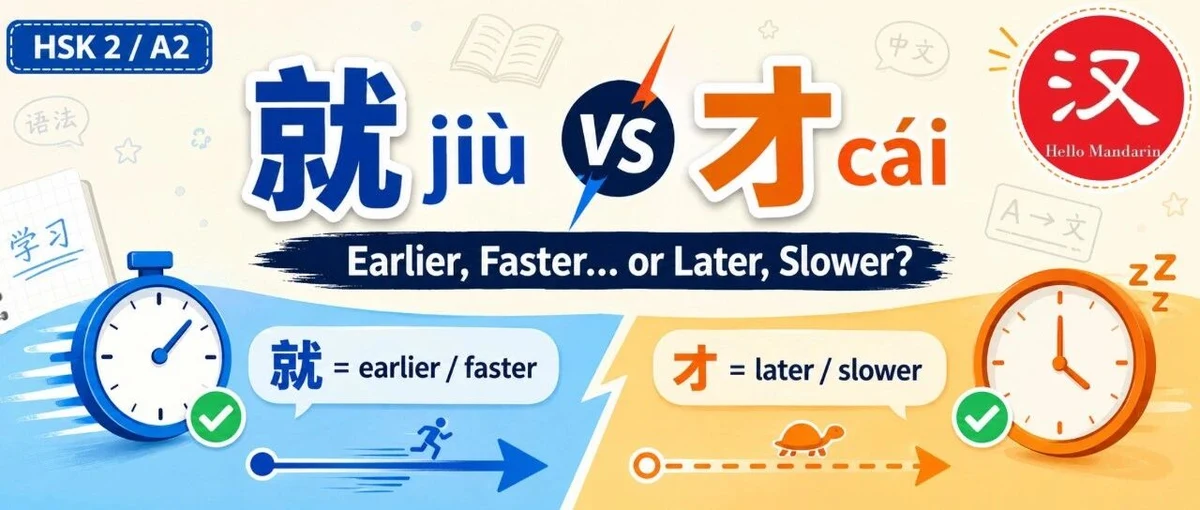
Many Chinese learners find 就 (jiù) and 才 (cái) confusing because both can talk about time, speed, and “only.”
But the main difference is actually simple:
就 = earlier / faster / easier than expected
才 = later / slower / harder than expected
Let’s look at the difference clearly. 😊
1. The Core Difference
就 (jiù): sooner than expected
Use 就 when something happens early, quickly, or easily.
他七点就来了。
He came as early as 7 o’clock.

👉 The feeling is:
“Wow, that was early.”
才 (cái): later than expected
Use 才 when something happens late, slowly, or only after some time.
他七点才来。
He didn’t come until 7 o’clock.
👉 The feeling is:
“Finally, he came. That was late.”

2. 就 and 才 with Time
This is the most common difference.
就 = already / as early as
我六点就起床了。
I got up as early as 6 o’clock.
她昨天就回家了。
She already went home yesterday.
才 = not until / only then
我十点才起床。
I didn’t get up until 10 o’clock.
她今天才回家。
She only went home today.

3. 就 and 才 with Speed or Difficulty
就 = it happened quickly or easily
我十分钟就写完了。
I finished writing it in only ten minutes.
👉 This means:
It was fast or easier than expected.
才 = it took a long time or was difficult
我三个小时才写完。
I only finished writing it after three hours.
👉 This means:
It was slow or harder than expected.

4. 就 and 才 with “Only”
Both 就 and 才 can sometimes be translated as “only,” but the feeling is different.
就 = only need / only takes / simple
坐地铁就二十分钟。
It only takes 20 minutes by subway.
👉 The feeling is:
“That’s not much. It’s easy or convenient.”
才 = only / so little
他才学了三个月中文。
He has only studied Chinese for three months.
👉 The feeling is:
“That’s not a lot of time.”

5. Common Sentence Pattern
A, 就 B
This means as soon as A happens, B happens.
我到家就给你发信息。
I’ll message you as soon as I get home.
你准备好了,我们就开始。
Once you’re ready, we’ll start.
A, 才 B
This means only after A happens, B can happen.
你来了,我才走。
Only after you come, I will leave.
做完作业,才可以看电视。
Only after finishing homework can you watch TV.

6. Compare These Sentences
他五点就到了。
He arrived as early as 5 o’clock.
✅ Earlier than expected.
他五点才到。
He didn’t arrive until 5 o’clock.
✅ Later than expected.
我一年就能说中文了。
I could speak Chinese after only one year.
✅ Fast progress.
我一年才会说一点中文。
After one year, I could only speak a little Chinese.
✅ Slower than expected.
7. A Simple Memory Tip
Remember this:
就 = earlier, faster, easier
才 = later, slower, only after
So when you choose between 就 and 才, don’t only think about the English translation.
Think about the speaker’s feeling:
Is it fast or early? → Use 就
Is it late or difficult? → Use 才
Final Summary
就 (jiù) often shows that something happens earlier, faster, or more easily than expected.
才 (cái) often shows that something happens later, more slowly, or only after a condition is met.
The key is not just time.
The key is the speaker’s expectation. 🎯
Once you understand this feeling, 就 and 才 become much easier to use.✨