
Chinese has several words that can be translated as “continue” or “continuous” in English.
Three of the most commonly confused ones are:
继续 (jìxù)
连续 (liánxù)
持续 (chíxù)
They are related, but they focus on different things.
Here is the easiest way to remember them:
👉 继续 = keep doing / resume something
👉 连续 = in a row / one after another
👉 持续 = last or continue over a period of time
Let’s look at the differences. 👇
1. 继续 (jìxù) — Keep Doing Something
继续 focuses on an action that has already started and then keeps going.
It can also mean that an action resumes after a pause.
Common pattern:
继续 + Verb / Verb Phrase
For example:
她想继续学中文。
She wants to continue learning Chinese.
She is already learning Chinese and wants to keep doing it.
Another example:
我们休息十分钟,然后继续上课。
We’ll take a ten-minute break and then continue the class.
The class pauses and then resumes.
You can also hear:
别停,继续说。
Don’t stop. Keep talking.
💡 Think:
继续 = Keep doing it.

2. 连续 (liánxù) — In a Row / One After Another
连续 emphasizes that something happens without a gap in the sequence.
It is especially common with:
days, hours, times, events, or repeated actions
For example:
他连续三天迟到了。
He was late three days in a row.
This does not mean that his lateness “lasted for three days.”
It means he was late on Day 1, Day 2, and Day 3 — three consecutive days.
Another example:
她连续工作了六个小时。
She worked for six hours straight.
Here, 连续 emphasizes that the work went on without a meaningful break.
One more:
他连续给我打了三次电话。
He called me three times in a row.
💡 Think:
连续 = in a row / straight

3. 持续 (chíxù) — Last / Continue Over Time
持续 focuses on duration — something remains, develops, or keeps happening over a period of time.
It is common with things such as:
weather, meetings, temperature, growth, change, pain, problems, activities, and trends.
For example:
会议持续了两个小时。
The meeting lasted for two hours.
The main question here is:
How long did it last?
Another example:
最近气温持续上升。
Recently, the temperature has continued to rise.
The change continues over time.
You can also say:
大雨还会持续一段时间。
The heavy rain will continue for a while.
And 持续 can appear before a noun:
持续的高温让人很累。
The persistent high temperatures are exhausting.
💡 Think:
持续 = How long does it last?

🔍 Compare All Three
Look at these three sentences:
我们休息一下,再继续工作。
Wǒmen xiūxi yíxià, zài jìxù gōngzuò.
Let’s take a short break and then continue working.
👉 继续 focuses on what we will keep doing.
他连续工作了六个小时。
Tā liánxù gōngzuò le liù ge xiǎoshí.
He worked for six hours straight.
👉 连续 emphasizes no meaningful break in the sequence.
会议持续了六个小时。
Huìyì chíxù le liù ge xiǎoshí.
The meeting lasted six hours.
👉 持续 emphasizes duration.
⭐ 连续 vs 持续: Sometimes Both Are Possible
Here is an important point.
Sometimes 连续 and 持续 can both be used in a similar sentence, but the focus changes.
Compare:
雨连续下了三天。
It rained for three days straight.
👉 连续 emphasizes that there was no meaningful break.
Now:
雨持续下了三天。
The rain continued for three days.
👉 持续 emphasizes how long the rain lasted.
Both sentences are natural.
The difference is what the speaker wants to emphasize.
连续 → continuity
持续 → duration
Another Useful Comparison
Compare:
这个活动连续举办了三天。
The event was held for three consecutive days.
Here, 连续 emphasizes that the three days came one after another.
But:
这个活动持续了三天。
The event lasted three days.
Here, 持续 simply tells us the duration of the event.
So:
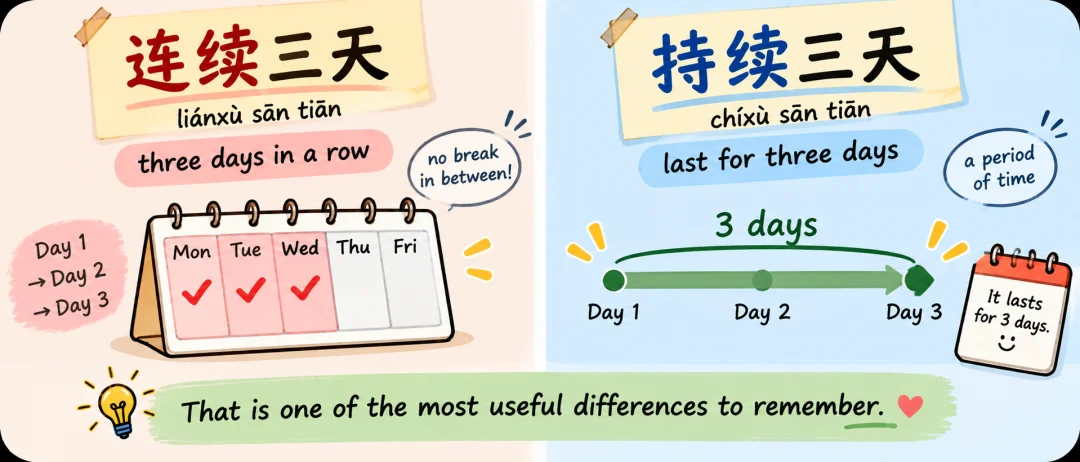
👉 连续三天 = three days in a row
👉 持续三天 = last for three days
That is one of the most useful differences to remember.
⚠️ A Common Learner Mistake
Suppose you want to say:
“I want to keep learning Chinese.”
The most natural everyday choice is:
我想继续学中文。
I want to keep learning Chinese.
Why?
Because you are talking about continuing an action you are already doing.
You may also see:
我想持续学习中文。
I want to keep studying Chinese over the long term.
This sentence is not wrong.
However, 持续学习 puts more emphasis on maintaining the activity over time and sounds slightly more formal.
For normal conversation, 继续学中文 is usually the more natural choice.
🧠 The 3-Second Rule
When you are not sure which word to use, ask yourself:
“Am I keeping or resuming an action?”
Use 继续.
继续学习
keep studying
“Is something happening in a row?”
Use 连续.
连续三天
three days in a row
“Am I talking about how long something lasts?”
Use 持续.
持续两个小时
last for two hours
✅ Final Reminder
Don’t memorize all three as simply “continue.”
Remember what each word focuses on:
继续 (jìxù) → the action keeps going
连续 (liánxù) → the sequence has no gap
持续 (chíxù) → the situation or process lasts over time
So:
Keep doing / resume it → 继续
In a row / straight → 连续
Last over time → 持续
Once you remember these three ideas, the difference becomes much easier. 😊