
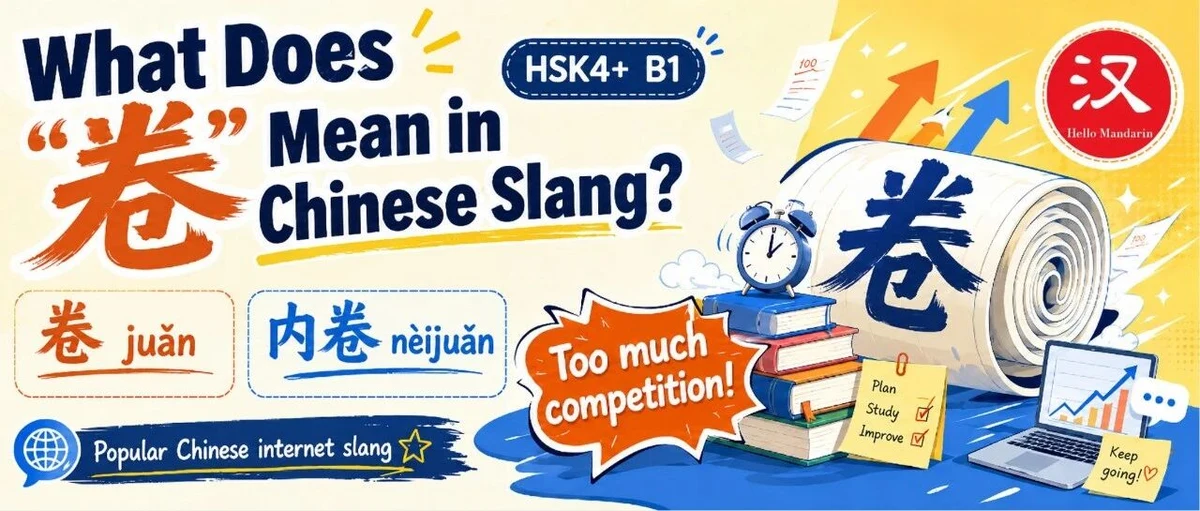
Have you ever heard someone in China say:
太卷了!
“It’s too competitive!”
The word 卷 is very common online and in daily conversation, especially when people talk about school, work, exams, or social pressure.
But be careful: 卷 does not simply mean “work hard.”
It often has a negative or joking feeling.
Let’s look at it clearly. 😊
1. The Basic Meaning of 卷 juǎn
The original meaning of 卷 is “to roll up” or “to curl.”
For example:
把纸卷起来。
Roll up the paper.
她的头发有点儿卷。
Her hair is a little curly.
So the basic image of 卷 is something rolling inward or curling up.

2. The Slang Meaning of 卷
In modern Chinese slang, 卷 comes from 内卷 nèi juǎn.
内卷 is often translated as “involution,” but for Chinese learners, a simpler explanation is:
Too much competition, too much effort, but not much real improvement.
For example, everyone studies longer, works later, or does more than before, but the final result may not become much better.
So 卷 usually means:
to compete too intensely
to push too hard because everyone else is doing it
to work harder and harder under pressure

3. The Most Useful Sentence: 太卷了!
太卷了!
It’s too competitive! / This is too much!
You can use it when a situation feels stressful because everyone is trying too hard.
Examples:
现在的学生太卷了。
Students nowadays are under too much competition.
这个行业太卷了。
This industry is too competitive.
我们公司太卷了,大家每天都加班。
Our company is too competitive. Everyone works overtime every day.

4. 卷 Is Not the Same as “努力”
Many learners may think:
卷 = work hard
But that is not exactly right.
努力 nǔlì is usually positive.
It means someone works hard to improve.
卷 juǎn often feels negative or ironic.
It means people are forced into strong competition because everyone is doing more and more.
Compare:
他很努力。
Tā hěn nǔlì.
He works very hard.
Positive feeling ✅
他太卷了。
Tā tài juǎn le.
He is too competitive / He pushes too hard.
Negative or joking feeling ⚠️

5. Common Ways to Use 卷
很卷 / 太卷了
Use this to describe a competitive environment.
这个班很卷。
This class is very competitive.
找工作太卷了。
Job hunting is too competitive.
不想卷了
This means “I don’t want to compete like this anymore.”
我不想卷了,我想休息一下。
I don’t want to keep competing like this. I want to take a break.
大家都在卷,可是我真的累了。
Everyone is competing so hard, but I’m really tired.
卷起来
This can mean “start competing hard.”
It is often used jokingly.
考试快到了,大家都卷起来了。
The exam is coming, and everyone has started working super hard.
别人都在学习,我也得卷起来了。
Everyone else is studying, so I guess I have to start pushing myself too.
卷王
卷王 juǎn wáng means “the king of over-competition.”
It describes someone who works extremely hard and makes everyone else feel pressure.
他每天学习十个小时,真是卷王。
He studies ten hours every day. He is really the “king of competition.”
This word is usually informal and a little humorous.

6. 内卷 nèi juǎn
内卷 is the more complete word.
It describes a social situation where competition becomes stronger and stronger, but people do not get much more in return.
Examples:
教育内卷很严重。
Involution in education is very serious.
很多年轻人觉得工作越来越内卷。
Many young people feel that work is becoming more and more competitive.

7. A Related Word: 躺平 tǎng píng
The opposite attitude of 卷 is often 躺平.
躺平 literally means “to lie flat.”
As slang, it means someone does not want to join extreme competition anymore.
Examples:
我不想卷了,我想躺平。
I don’t want to compete like this anymore. I just want to lie flat.
Of course, this is often said jokingly, not always literally.

8. Quick Summary 🎯
卷 juǎn
= to compete too hard
= too much pressure
= everyone is trying harder and harder
= often used in school, work, and online discussions
太卷了!
= It’s too competitive! / This is too much!
Remember:
努力 is usually positive.
卷 often has a negative or joking feeling.
So next time you hear Chinese people say “太卷了!”, you’ll know they are not talking about rolling paper.
They are talking about pressure, competition, and modern life. 🌪️