
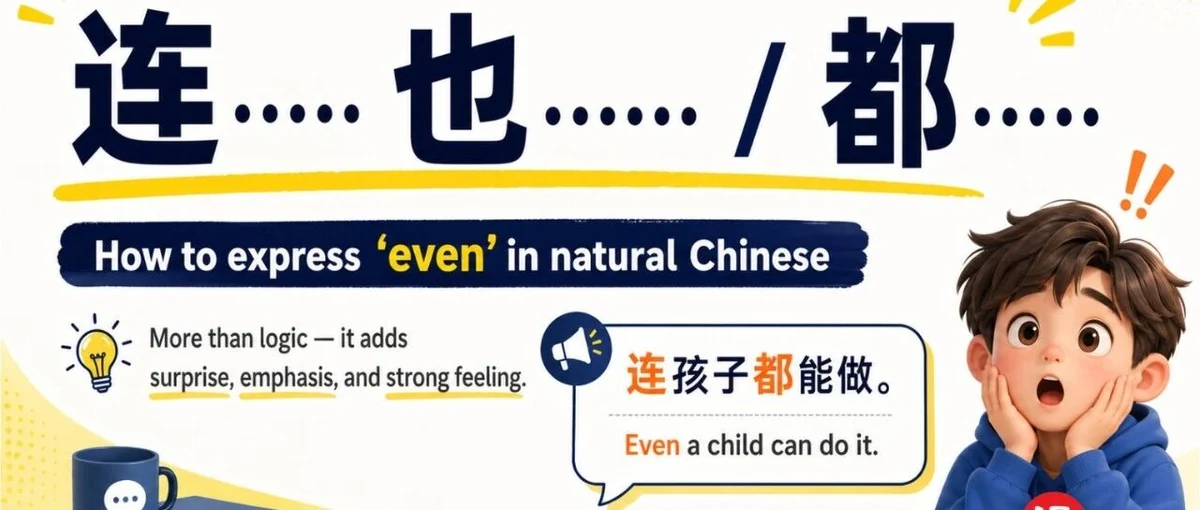
When Chinese learners first meet 连……也…… / 都……, they usually translate it as “even…” in English. That is basically correct — but the real feeling of this pattern is stronger than a simple direct translation.
This structure is used to highlight an unexpected, surprising, extreme, or unlikely case. It often gives the feeling of:
“Not only the normal case, but even this one.”
So instead of thinking of it only as a logic pattern, it is better to think of it as an emphasis pattern. It draws attention to something the speaker finds surprising, strong, or worth stressing. ✨
For example:
连孩子都能做。
Even a child can do it.
The idea is: this thing is so easy that even a child can do it.
This is why 连……也…… / 都…… is so useful in natural Chinese.
What does 连……也…… / 都…… mean?
In English, it often means:
even
even…also
so…that even…
It is used when the speaker wants to emphasize that something is true in a case that is more extreme, unexpected, or less likely than usual.
So your original explanation is close, but it needs one important correction:
It is not always about “if an extreme case is true, then ordinary cases are naturally true.”
More accurately, it is about highlighting an extreme or unexpected case for emphasis.
That is the core idea learners should remember.
Basic structure
The pattern is usually:
连 + emphasized element + 也 / 都 + predicate
The “emphasized element” can be a person, thing, place, time, action, or sometimes even a whole phrase.
For example:
连老师也不知道。
Even the teacher doesn’t know.
连这个问题我都不会。
Even this question, I can’t do.
So your sentence
“连 + subject of comparison + 也/都 + verb”
is a bit too narrow.
A better and more accurate explanation is:
连 + the part you want to emphasize + 也 / 都 + the rest of the sentence
Do we have to use 也 or 都?
In standard learner grammar, 连 is normally paired with 也 or 都.
So learners should treat them as a fixed pattern:
连……也……
连……都……
Both are very common, and in many cases they are interchangeable.
Compare:
连他也来了。
Even he came.
连他都来了。
Even he came.
Both are correct.
In many teaching situations, it is enough to tell students:
也 and 都 both work here, and the difference is usually small.
都 often sounds a little stronger or more emphatic in actual speech.
How to understand the word order
One thing that confuses learners is the position of 连.
In this pattern, the thing being emphasized is moved forward and placed after 连.
For example:
Normal sentence:
我听懂了这个问题。
Wǒ tīng dǒng le zhège wèntí.
I understood this question.
With emphasis:
连这个问题我都听懂了。
Lián zhège wèntí wǒ dōu tīng dǒng le.
Even this question, I understood.
The speaker is not just saying “I understood it.”
The speaker is saying: “This question may have seemed difficult, but I understood even this one.”
That is the emotional force of the pattern.
When do Chinese speakers use 连……也…… / 都……?
This structure is especially common when the speaker wants to show:
surprise,
emphasis,
unexpectedness,
extremeness,
or strong feeling.
Let’s look at some natural examples.
1. Even a child can do it
这件事很简单,连孩子都能做。
This matter is very simple; even a child can do it.
Here, 孩子 is the extreme example. The speaker uses it to show how easy the task is.
2. Even the teacher does not know
这个问题太难了,连老师也不知道。
This question is too difficult; even the teacher doesn’t know.
This sentence emphasizes the difficulty of the question.
3. He was so tired that he did not even eat
他太累了,连饭都没吃就睡了。
He was so tired that he went to sleep without even eating.
This is a very common type of sentence in daily Chinese.
The speaker emphasizes that eating, something very normal, did not happen.
4. I could not even say one sentence
我当时太紧张了,连一句话都说不出来。
I was so nervous at that time that I couldn’t even say a single sentence.
This sentence is very useful for learners because it shows that 连 can emphasize quantity too.
5. Even coffee cannot wake me up
我昨天睡得太晚了,今天连咖啡都救不了我。
I slept too late yesterday. Today, even coffee can’t save me.
This example is a little playful and very natural for modern spoken Chinese. ☕️
6. She even forgot her own birthday
她最近太忙了,连自己的生日都忘了。
She has been so busy lately that she even forgot her own birthday.
This emphasizes the surprising degree of her busyness.
7. Even beginners can understand this grammar point
这个语法点解释得很清楚,连初学者都能看懂。
This grammar point is explained very clearly; even beginners can understand it.
This is a useful sentence style for teaching content too.
8. He did not even look at me
他生气了,连看都没看我一眼。
He was angry. He didn’t even look at me once.
This shows that 连 can also emphasize an action.
连 can emphasize different things
Many students think 连 can only be used before a person or noun. That is not true.
It can emphasize:
a person
连他都不知道。
Lián tā dōu bù zhīdào.
Even he doesn’t know.
a thing
连这个我都不会。
Lián zhège wǒ dōu bú huì.
Even this I can’t do.
an action
他连解释都不解释。
Tā lián jiěshì dōu bù jiěshì.
He doesn’t even explain.
a quantity
我连一百块钱都没有。
Wǒ lián yì bǎi kuài qián dōu méiyǒu.
I don’t even have 100 yuan.
a time expression
他连周末都在工作。
Tā lián zhōumò dōu zài gōngzuò.
He is working even on weekends.
So the key is not “subject of comparison.”
The key is: what do you want to highlight as surprising or extreme?
连……也…… vs 连……都……
For most learners, both patterns can be treated as equivalent.
连他也会说汉语。
Even he can speak Chinese.
连他都会说汉语。
Even he can speak Chinese.
In everyday usage, 都 often sounds a bit more forceful, natural, and common in spoken emphasis.
But this is not a hard rule. In beginner and intermediate teaching, it is fine to say:
Both are correct.
Both mean “even.”
Use whichever sounds more natural in the sentence.
Common mistakes learners make
One common mistake is forgetting 也 or 都.
Incorrect:
连他会说汉语。
Better:
连他也会说汉语。
Lián tā yě huì shuō Hànyǔ.
Even he can speak Chinese.
Or:
连他都会说汉语。
Lián tā dōu huì shuō Hànyǔ.
Even he can speak Chinese.
Another common mistake is using the pattern without any sense of emphasis.
For example, if the sentence does not contain surprise, extremeness, or contrast, then 连……也/都…… may sound unnatural.
So learners should not think of this as only a grammar formula.
It is also a pattern of speaker attitude.
A useful way to feel the sentence
When you use 连……也…… / 都……, ask yourself:
“What is the surprising part?”
If you can clearly answer that question, your sentence will usually sound natural.
For example:
连老师都不知道。
What is surprising?
→ Even the teacher doesn’t know.
连一杯水都没喝。
What is surprising?
→ Not even one glass of water was drunk.
连中文名字都有了。
What is surprising?
→ The person has gone so far that they even have a Chinese name now.
This way of thinking is much more useful than memorizing a dry formula. 😊
Compare these two sentences
他没吃饭。
He didn’t eat.
他连饭都没吃。
He didn’t even eat.
Both are grammatically correct, but the second one has much stronger emotion and emphasis.
That is exactly what 连……也…… / 都…… does.
Final tip
When you want to say “even…” in Chinese, and you want the sentence to sound more vivid, emphatic, and natural, 连……也…… / 都…… is one of the best patterns to use.
Remember this core idea:
连 introduces the surprising or extreme element.
也 / 都 completes the emphasis.
The whole pattern shows:
“Not only in normal cases — even in this case.”
Once learners understand that feeling, this grammar point becomes much easier to use in real conversation.
Quick summary
连……也…… / 都…… means “even…”
It is used to emphasize an unexpected, surprising, or extreme case
The structure is:
连 + emphasized element + 也 / 都 + predicate
Examples:
连孩子都能做。
Even a child can do it.
连老师也不知道。
Even the teacher doesn’t know.
他太累了,连饭都没吃。
He was so tired that he didn’t even eat.