
Includes a few useful restaurant expressions beyond these levels.
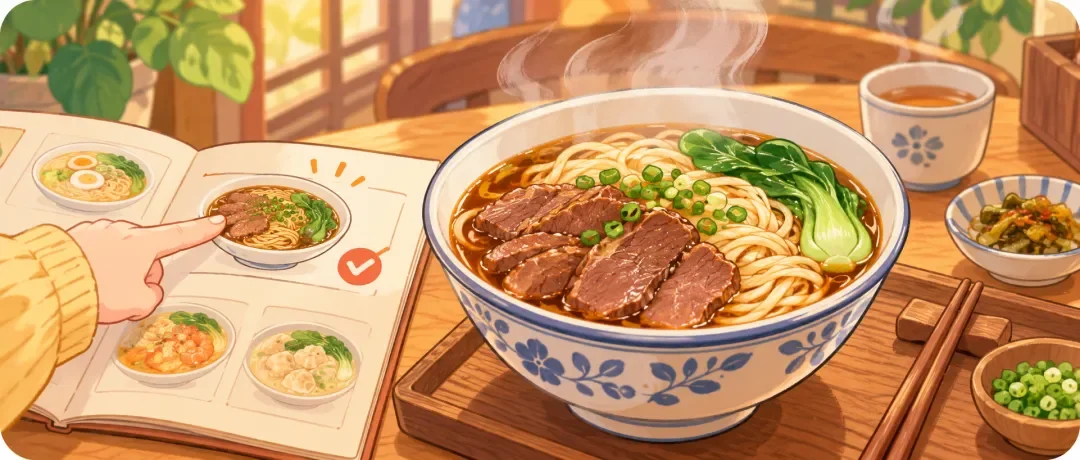
You walk into a restaurant in China, look at the menu, and confidently say:
我要一碗牛肉面。
I’d like a bowl of beef noodles.
Easy, right? 😎
But then the server starts asking questions.
Large or small? Spicy or not? For here or to go?
Suddenly, ordering food feels a little harder!
The good news? Most of these questions are short, and your answers can be even shorter.
Here are six common questions that will help you order food more confidently in Chinese.
🍽️ 1. 想好了吗?(Xiǎng hǎo le ma?)
Have you decided what you’d like?
When you’ve been looking at the menu for a while, the server might ask:
服务员:想好了吗?
Have you decided what you’d like?
✅ If you’re ready:
想好了,我要一碗牛肉面。
Yes, I’d like a bowl of beef noodles.
✅ If you need more time:
我再看一下。
Let me have another look.
💡 Useful tip: 我再看一下 is a natural way to ask for a little more time. You don’t need a long explanation.
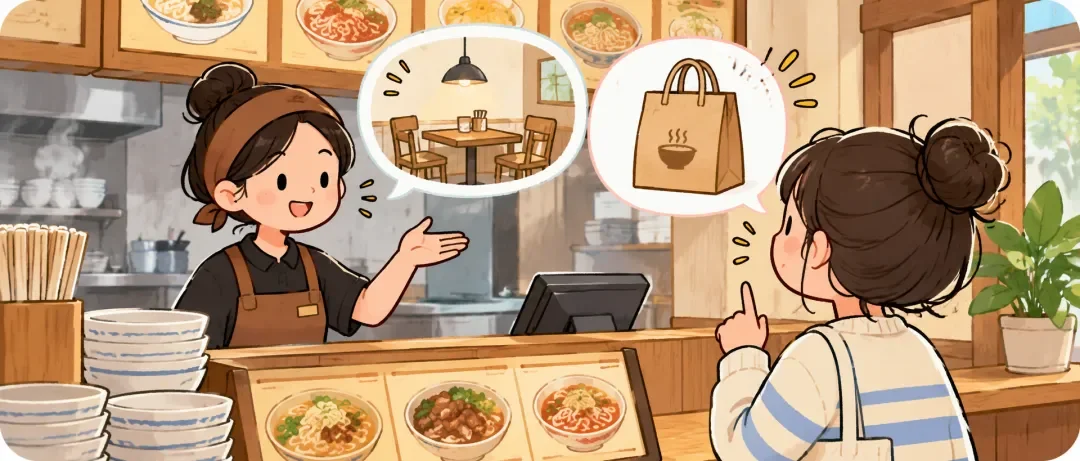
🥡 2. 在这儿吃还是带走?(Zài zhèr chī háishi dài zǒu?)
For here or to go?
You’ll often hear this at noodle shops, small restaurants, and takeaway counters.
服务员:在这儿吃还是带走?
For here or to go?
✅ If you’re eating there:
在这儿吃。
For here.
✅ If you’re taking the food away:
打包,谢谢。
To go, thanks.
📌 You might also hear:
堂食还是打包?
For here or to go?
Don’t worry about memorizing both questions immediately. Just remember:
在这儿吃 = eat here
打包 / 带走 = take away
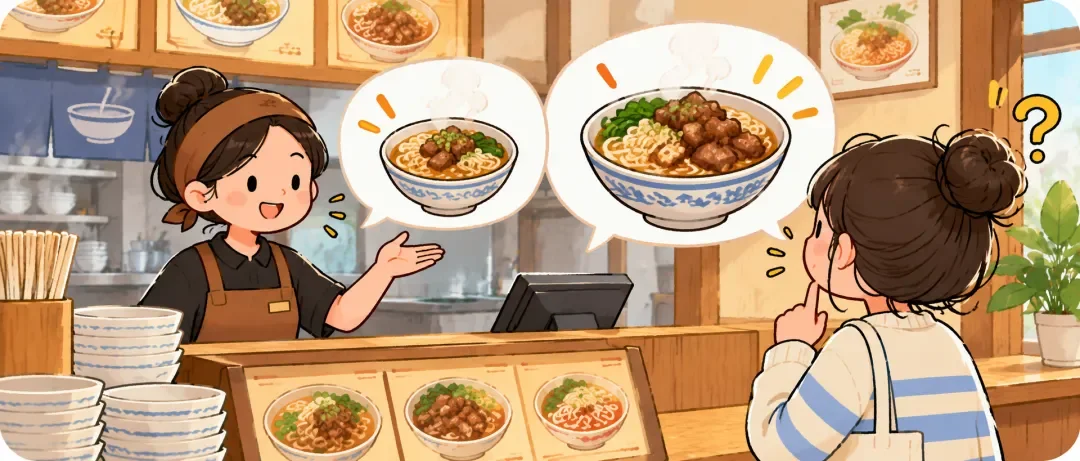
🍜 3. 大碗还是小碗?(Dà wǎn háishi xiǎo wǎn?)
Large or small?
You’ve ordered noodles, and the server asks:
服务员:大碗还是小碗?
Large or small?
✅ You can answer:
小碗就好。
A small bowl is fine.
Or:
我要大碗的。
I’d like the large one.
💡 Pay attention to 还是 (háishi)!
In questions like this, 还是 means “or.”
The server is giving you a choice.
大碗还是小碗?
Large or small?
You can simply choose one. No complicated sentence needed!
And 就好 (jiù hǎo) is a useful way to say that a particular option is enough for you.
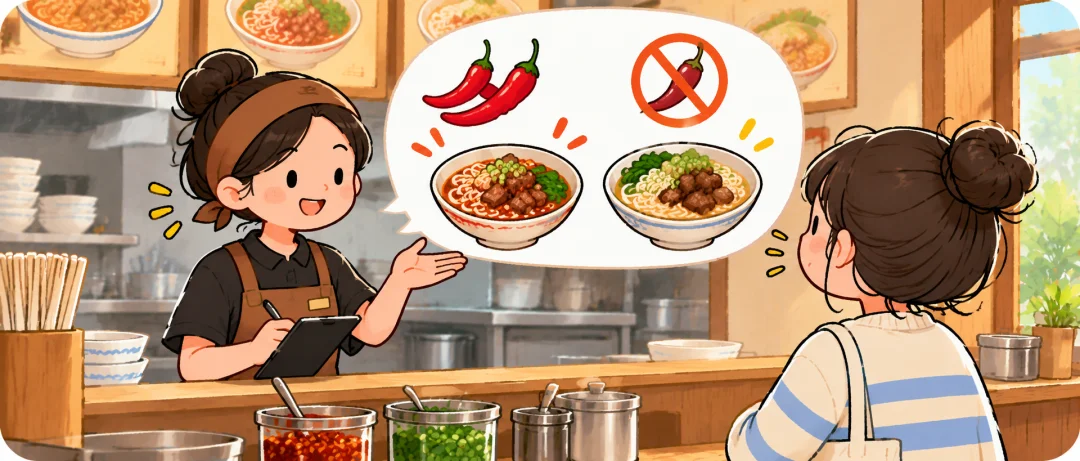
🌶️ 4. 要辣吗?(Yào là ma?)
Would you like it spicy?
This is a question you’ll want to understand, especially if you don’t eat spicy food!
服务员:要辣吗?
Would you like it spicy?
✅ Not spicy:
不要辣,谢谢。
Not spicy, please.
✅ A little spicy:
微辣就好。
Just mildly spicy, please.
✅ Spicy:
要辣的。
I’d like it spicy.
🌶️ Remember:
不辣 (bú là) — not spicy
微辣 (wēilà) — mildly spicy
很辣 (hěn là) — very spicy
很辣 describes how spicy something is. If you want the server to make your dish spicier, you can ask them to add more chili.
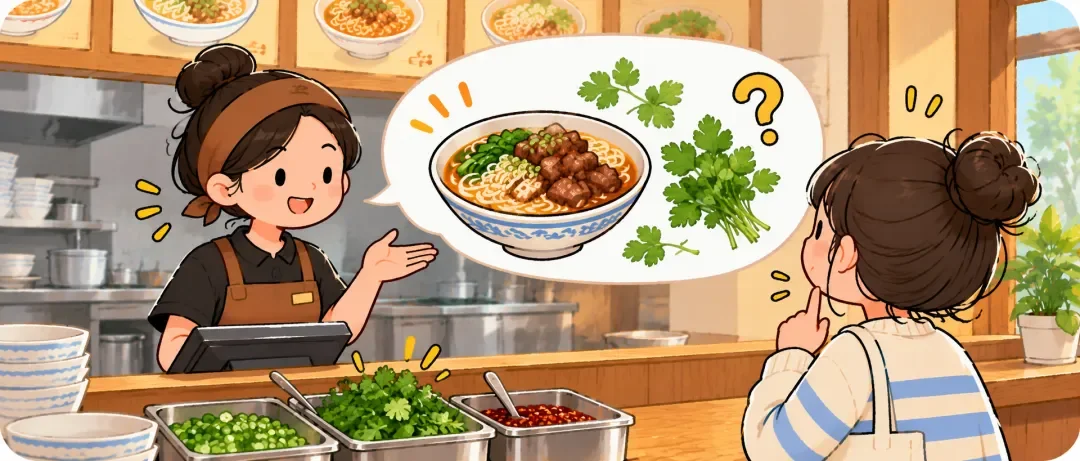
🌿 5. 加香菜吗?(Jiā xiāngcài ma?)
Would you like cilantro?
At some noodle shops, the server may ask whether you’d like cilantro added to your food.
服务员:加香菜吗?
Would you like cilantro?
✅ If you want some:
加一点吧。
Just a little, please.
✅ If you don’t want any:
不要香菜,谢谢。
No cilantro, thanks.
💡 Useful word: 加 (jiā) — to add
You’ll hear 加 in many food-related situations.
And if you don’t want an ingredient, 不要 + Ingredient is a simple, useful expression.
For example:
不要放辣椒。
Please don’t add chili peppers.
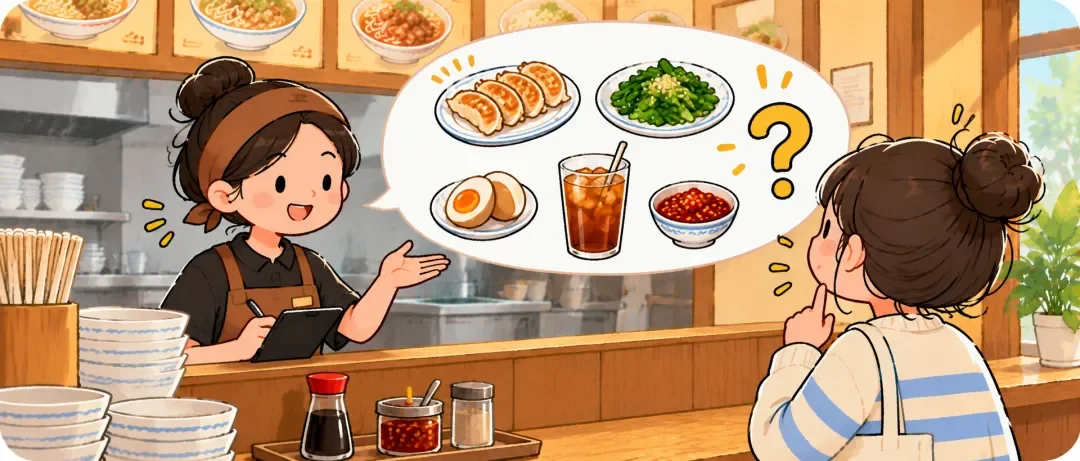
🥤 6. 还要别的吗?(Hái yào bié de ma?)
Anything else?
You’ve ordered your meal, but the server wants to know if you need anything more.
服务员:还要别的吗?
Anything else?
✅ If you’re finished ordering:
不用了,谢谢。
No, thanks. That’s all.
✅ If you want to add something:
还要一瓶水。
I’d also like a bottle of water.
💡 Useful tip: 不用了,谢谢 is a polite, natural answer when you don’t need anything else.
You can use it in many everyday situations, not just restaurants.
😅 7. What If the Server Speaks Too Fast?
Even if you’ve learned all these expressions, real conversations can still be challenging.
People might speak quickly, and you might miss a few words.
That’s completely normal!
Here are two useful phrases:
不好意思,可以再说一遍吗?
Sorry, could you say that again?
请说慢一点。
Please speak a little more slowly.
You don’t need to pretend you understood everything.
Asking someone to repeat a question is part of speaking Chinese in real life!
🗣️ 8. Let’s Put It All Together!
Imagine you’re at a noodle shop in China.
👩🍳 服务员:在这儿吃还是带走?
For here or to go?
🧑 顾客:在这儿吃。
For here.
👩🍳 服务员:想好了吗?
Have you decided what you’d like?
🧑 顾客:想好了,我要一碗牛肉面。
Yes, I’d like a bowl of beef noodles.
👩🍳 服务员:大碗还是小碗?
Large or small?
🧑 顾客:小碗就好。
A small bowl is fine.
👩🍳 服务员:要辣吗?
Would you like it spicy?
🧑 顾客:微辣就好,不要香菜。
Just mildly spicy, please. No cilantro.
👩🍳 服务员:还要别的吗?
Anything else?
🧑 顾客:不用了,谢谢。
No, thanks. That’s all.
👩🍳 服务员:好的,请稍等。
Sure. Just a moment, please.
🎉 You did it!
You’ve just handled a complete restaurant ordering conversation in Chinese.
⭐ The Secret to Ordering Food in Chinese
You don’t need to understand every single word.
Start by listening for key words:
辣 (là) → spicy
大碗 (dà wǎn) → large bowl
小碗 (xiǎo wǎn) → small bowl
打包 (dǎbāo) → takeaway
还要 (hái yào) → want anything more / also want
Once you recognize these words, it becomes much easier to understand what the server is asking.
And remember: Short answers are perfectly natural in Chinese!
💬 Your Turn!
Imagine you’re ordering noodles in China.
The server asks:
要辣吗?
Would you like it spicy?
How would you answer?
① 不要辣。
② 微辣就好。
③ 要辣的。
Keep practicing, and 加油 (jiāyóu)!