
A Practical Guide to Chinese Weather Expressions
Weather is one of the most common topics in daily conversation. Whether you are chatting with friends, making small talk, or planning activities, talking about the weather is very useful.
In Chinese, discussing the weather is actually quite simple once you learn a few key patterns and vocabulary. In this guide, you will learn how to ask about the weather, describe temperature, and talk about seasons and rain in Chinese. 🌤️
1️⃣ Asking About the Weather
The most common way to ask about the weather in Chinese is:
今天天气怎么样?
English: How is the weather today?
Here, 天气 (tiānqì) means weather, and 怎么样 (zěnmeyàng) means how is it / what is it like.
You can also ask about the weather in a specific place:
北京的天气怎么样?
English: How is the weather in Beijing?
上海今天的天气怎么样?
English: What is the weather like in Shanghai today?
💡 Structure
Location + 的 + 天气 + 怎么样?

2️⃣ General Weather Responses
When someone asks about the weather, you can answer with simple descriptive sentences.
今天天气很好。
English: The weather is very nice today.
今天天气不错。
English: The weather is pretty good today.
今天天气不太好。
English: The weather is not very good today.
You can also be more specific:
今天有点冷。
English: It’s a little cold today.
今天挺热的。
English: It’s quite hot today.
3️⃣ Talking About the Temperature
Another important part of weather conversations is temperature.
The word for temperature in Chinese is:
温度 (wēndù) – temperature
To ask about the temperature, you can say:
今天多少度?
English: What’s the temperature today?
Or more formally:
今天的温度是多少?
English: What is the temperature today?
Example responses:
今天20度左右。
English: It’s around 20°C today.
今天30度,很热。
English: It’s 30°C today, very hot.

4️⃣ Celsius vs. Fahrenheit
In China, people normally use Celsius (摄氏度 shèshìdù) when talking about temperature.
Fahrenheit is called:
华氏度 (Huáshìdù)
For example:
0°C = 32°F
When the temperature is below zero, Chinese uses the expression:
零下 (língxià) – below zero
Example:
今天零下5度。
English: It’s minus five degrees today.

5️⃣ The Four Seasons in Chinese
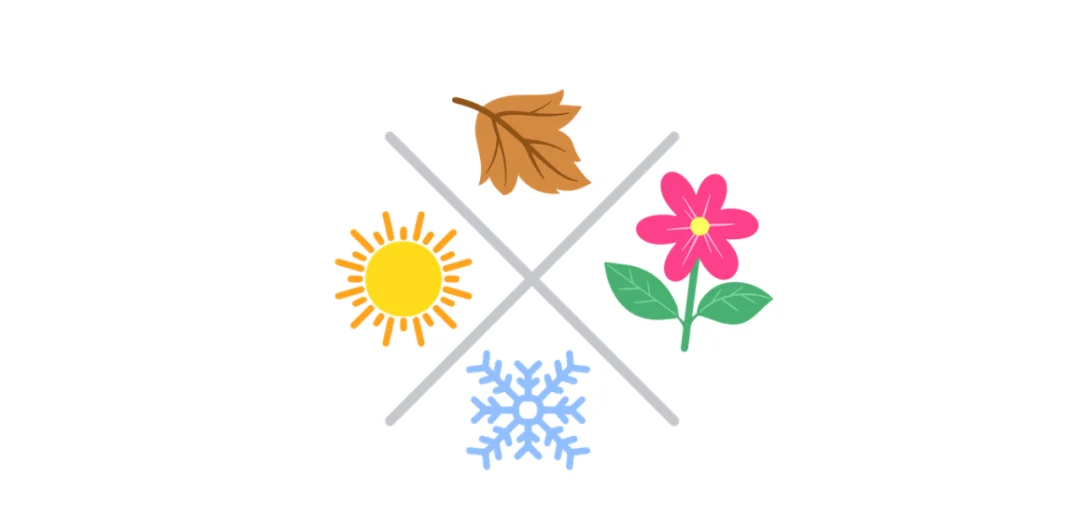
There are four seasons in a year.
春天 (chūntiān) – spring
夏天 (xiàtiān) – summer
秋天 (qiūtiān) – autumn / fall
冬天 (dōngtiān) – winter
Example sentence:
一年有四个季节。
English: There are four seasons in a year.
Another example:
我最喜欢春天,因为天气很舒服。
English: I like spring the most because the weather is very comfortable.
6️⃣ Basic Weather Vocabulary
Here are some very common weather expressions in Chinese.
晴天 (qíngtiān) – sunny
多云 (duōyún) – cloudy
下雨 (xiàyǔ) – rainy
下雪 (xiàxuě) – snowy
有风 (yǒu fēng) – windy
Example sentences:
今天是晴天。
English: Today is sunny.
今天多云。
English: It’s cloudy today.
今天下雪了。
English: It’s snowing today.

7️⃣ Different Types of Rain in Chinese
The general word for rain is:
雨 (yǔ) – rain
But Chinese also has many specific types of rain.
小雨 (xiǎoyǔ) – light rain
中雨 (zhōngyǔ) – moderate rain
阵雨 (zhènyǔ) – rain shower
雷阵雨 (léi zhènyǔ) – thunder shower
暴雨 (bàoyǔ) – heavy rain / torrential rain
雨天 (yǔtiān) – rainy day
Example:
今天下大雨。
English: It’s raining heavily today.
Another example:
今天有阵雨,记得带伞。
English: There will be rain showers today, remember to bring an umbrella.

🌦️ Key Takeaways
When talking about the weather in Chinese, remember these important points:
✅ Use 天气 (tiānqì) to talk about weather.
✅ Ask about the weather with 今天天气怎么样?
✅ Temperature is expressed with 度 (dù).
✅ China normally uses Celsius (摄氏度).
✅ Learn basic weather vocabulary like 晴天、下雨、下雪、多云.
Once you master these expressions, you will find that talking about the weather in Chinese becomes very easy and natural.
So next time you meet a Chinese friend, try starting a conversation with:
今天天气怎么样? ☀️