
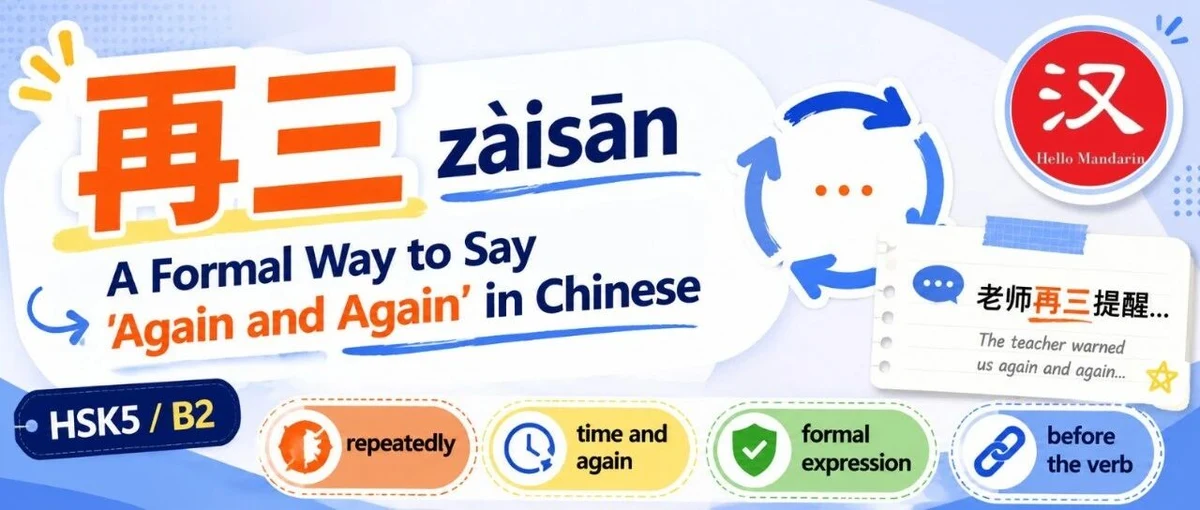
In Chinese, if you want to say someone does something again and again, especially in a serious, careful, or formal way, you can use 再三 zàisān.
再三 means repeatedly, time and again, or over and over again.
It is often used when someone reminds, emphasizes, explains, asks, confirms, considers, requires, or apologizes many times.
1. What Does 再三 Mean?
再三 is a formal adverb.
It shows that an action is done many times, usually with a clear purpose or serious attitude.
You will often see 再三 in written Chinese, formal speech, news reports, notices, meetings, and serious conversations.
For example:
老师再三提醒学生考试前要检查答案。
The teacher repeatedly reminded the students to check their answers before the exam.
Here, 再三提醒 means the teacher did not remind them only once. The teacher reminded them many times.
2. Basic Structure
The most common structure is:
Subject + 再三 + Verb Phrase
For example:
我再三提醒他。
I reminded him again and again.
再三 is usually placed before the verb phrase.
It often appears with two-syllable verbs, such as:
提醒 tíxǐng — to remind
强调 qiángdiào — to emphasize
解释 jiěshì — to explain
考虑 kǎolǜ — to consider
确认 quèrèn — to confirm
要求 yāoqiú — to require / to request
道歉 dàoqiàn — to apologize
叮嘱 dīngzhǔ — to repeatedly remind / to carefully tell someone
But 再三 can also be used with some one-syllable verbs, such as 问 wèn, 说 shuō, and 劝 quàn, when the context is clear.
For example:
我再三问他,他还是不肯说。
I asked him again and again, but he still refused to say anything.

3. Common Examples
Example 1
妈妈再三叮嘱我路上注意安全。
My mom repeatedly reminded me to stay safe on the way.
再三叮嘱 sounds caring and serious. It means someone carefully reminds another person many times.
Example 2
他再三解释这件事跟他没有关系。
He explained again and again that this matter had nothing to do with him.
再三解释 means someone explains many times because they want others to understand or believe them.
Example 3
经理再三强调客户信息必须保密。
The manager repeatedly emphasized that customer information must be kept confidential.
再三强调 is very common in formal situations, such as meetings, notices, and speeches.
Example 4
我再三考虑,最后还是决定拒绝这份工作。
After thinking it over again and again, I finally decided to turn down this job offer.
再三考虑 means someone thinks carefully many times before making a decision.
Example 5
我已经再三确认,这个地址是正确的。
I have confirmed again and again that this address is correct.
再三确认 means someone checks something carefully many times.
4. Important Usage Notes
1. 再三 sounds formal
再三 is more formal than simply saying “again and again.”
In daily Chinese, you may also hear:
一次又一次 yí cì yòu yí cì
again and again
一遍又一遍 yí biàn yòu yí biàn
over and over again, usually for repeating an action from beginning to end
反复 fǎnfù
repeatedly / repeatedly doing something
Compare these sentences:
他一遍又一遍地练习发音。
He practiced pronunciation over and over again.
This sentence sounds natural because pronunciation practice is repeated many times.
Now look at this sentence:
老师再三强调发音的重要性。
The teacher repeatedly emphasized the importance of pronunciation.
This sounds more formal and serious.

2. 再三 is not only for the past
再三 is often used to describe repeated actions that have already happened, but it can also be used for general statements, formal requirements, or future reminders.
For example:
医生会再三提醒病人按时吃药。
Doctors will repeatedly remind patients to take medicine on time.
学校再三要求学生遵守规定。
The school repeatedly requires students to follow the rules.
So, do not think of 再三 as only a “past tense” expression.
3. 了 and 过 can appear with 再三
Learners can first remember the basic pattern:
再三 + Verb Phrase
For example:
我再三考虑,还是觉得不合适。
After thinking it over again and again, I still feel it is not suitable.
However, in real Chinese, 了 and 过 can also appear with 再三.
For example:
他再三强调了这个问题的重要性。
He repeatedly emphasized the importance of this issue.
我再三问过他,但他一直不回答。
I asked him again and again, but he kept refusing to answer.
The key point is:
再三 shows repetition.
了 and 过 show aspect or experience.
They have different functions.
5. Common Mistakes
Mistake 1: Using 再三 for casual repeated actions
This sentence sounds unnatural:
我再三喝咖啡。
Wǒ zàisān hē kāfēi.
Why?
Because 再三 is not usually used just to count repeated daily actions. It is more often used for intentional or serious actions, such as reminding, explaining, emphasizing, confirming, considering, or apologizing.
A more natural sentence would be:
我今天喝了好几次咖啡。
I drank coffee several times today.
Mistake 2: Confusing 再 and 再三
再 means again or one more time.
再三 means many times, often with a serious or formal feeling.
Compare:
请再说一遍。
Please say it one more time.
老师再三说明这个语法点。
The teacher explained this grammar point again and again.
6. More Useful Sentences
医生再三提醒他少吃糖。
The doctor repeatedly reminded him to eat less sugar.
公司再三要求员工保护客户隐私。
The company repeatedly required employees to protect customer privacy.
她再三道歉,希望朋友能原谅她。
She apologized again and again, hoping her friend could forgive her.
老师再三劝他不要放弃。
The teacher repeatedly advised him not to give up.
7. Quick Summary
再三 zàisān means repeatedly, time and again, or again and again.
It is a formal adverb.
The most common structure is:
Subject + 再三 + Verb Phrase
Use 再三 with actions that sound serious, careful, or purposeful.
Common phrases include:
再三提醒 — to remind again and again
再三强调 — to emphasize again and again
再三解释 — to explain again and again
再三考虑 — to think over again and again
再三确认 — to confirm again and again
再三要求 — to require repeatedly
再三道歉 — to apologize again and again
If you want your Chinese to sound more formal and precise, 再三 is a very useful word to know. 📌