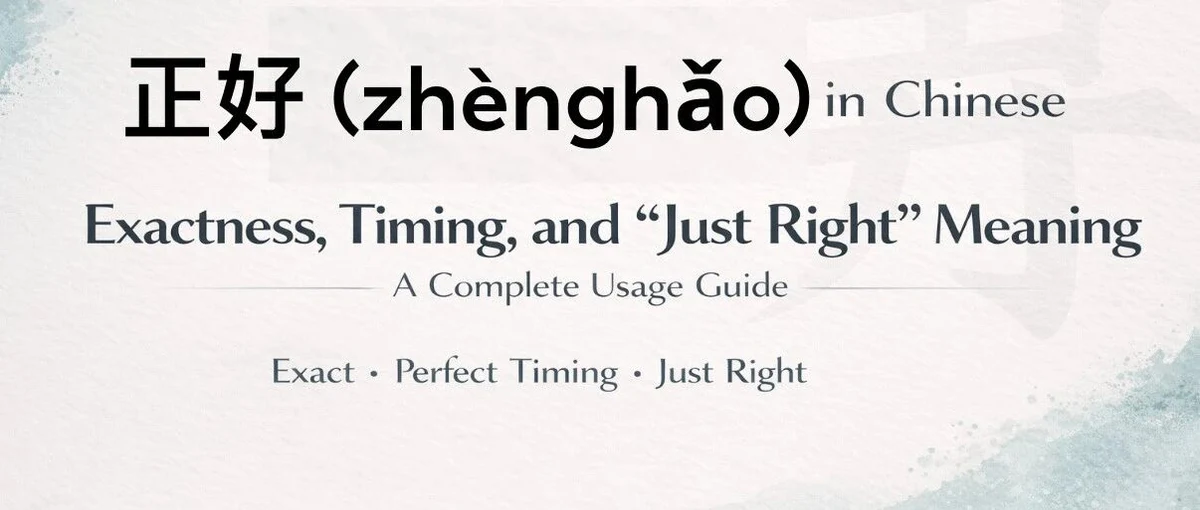
If you translate 正好 (zhènghǎo) as only “exactly,” you’ll miss half of its real power.
In modern Mandarin, 正好 is a high-frequency expression used to describe:
✅ the exact number / exact degree
✅ the perfect timing (a coincidence in time)
✅ something that is just right (neither too much nor too little)
It’s common in daily conversation and also appears in written Chinese. In this article, you’ll learn its part of speech, core meanings, key patterns, and typical mistakes — with clear examples you can copy and use. ✨
1️⃣ Part of Speech (词性)
正好 (zhènghǎo) is most commonly used as:
-
Adverb (副词) — modifying a verb or the whole sentence
-
Sometimes Adjective-like in certain contexts (meaning “just right”), but in grammar explanations for learners, treat it mainly as an adverb.
Core idea:
👉 正好 = “exactly / just / happen to / just right”
It often expresses a perfect match: quantity, degree, or timing matches the situation.
2️⃣ The Three Core Meanings of 正好
A) “Exactly / precisely” (数量、程度刚刚好)
This usage focuses on an exact match in number or degree.
📌 Common Patterns (with Pinyin + English)
正好 + 数量 / 时间 / 程度
exactly + (a number / time / degree)
(数量/程度) + 正好
exactly the right amount/degree
📌 Examples
-
这件衣服正好合适。
This piece of clothing fits exactly right.
-
今天带的钱正好够买票。
The money I brought today is exactly enough to buy a ticket.
-
从这里到地铁站走路正好十分钟。
From here to the subway station, it’s exactly a 10-minute walk.
👉 Key feeling: no extra, no shortage.

B) “Happen to / just at the right time” (时间上碰巧)
This is one of the most natural spoken uses.
It means: the timing is a coincidence — it happens right when needed.
📌 Common Patterns (with Pinyin + English)
正好 + V
happen to + do (something)
正好 + 在 + 时间点 / 地点
happen to be at + a time/place
我正好要…
I was just about to… / It happens I need to…
📌 Examples
-
你来得正好,我们正要开始。
You came just in time. We were about to start.
-
我正好想找你。
I was just thinking of looking for you.
-
我正好在附近,可以过去帮你。
I happen to be nearby, so I can go help you.
-
他打电话的时候,我正好在开会。
When he called, I happened to be in a meeting.
👉 Key feeling: a coincidence that fits perfectly.

C) “Just right” (恰到好处;刚刚好)
This usage often evaluates something as perfectly suitable.
📌 Common Patterns (with Pinyin + English)
正好 + 形容词
just right + adjective
对我来说正好
it’s just right for me
📌 Examples
-
这个温度正好,不冷也不热。
This temperature is just right—not cold and not hot.
-
你说得正好,我也这么想。
What you said is exactly right—I think so too.
-
这个难度对我来说正好。
This difficulty level is just right for me.

3️⃣ 正好 vs 刚好 vs 恰好 (Key Comparison)
These three are close, and learners often confuse them.
正好: most common in daily use; “exactly / just right / just in time”
刚好: very similar; often emphasizes “no more, no less” (especially quantity)
恰好: more formal/literary; common in written style
Quick examples:
-
钱正好够。/ 钱刚好够。 (both natural)
The money is exactly enough.
-
恰好相反。 (more formal)
It happens to be the opposite.
Practical advice:
👉 In most daily situations, use 正好 safely.

4️⃣ Common Learner Mistakes (常见错误)
Mistake 1: Using 正好 when you mean “now/at the moment”
正好 is not “now.” It is “exactly / just right / perfect timing.”
Correct:
我现在在忙。
Wǒ xiànzài zài máng.
I’m busy now.
Not:
✗ 我正好在忙。 (means: I happen to be busy, coincidence feeling)
Mistake 2: Forgetting the “match” meaning
If there is no “match” (quantity/degree/timing), 正好 can sound strange.
✅ Final Summary
正好 (zhènghǎo) expresses a perfect match in:
-
quantity/degree — exactly enough, exactly right
-
timing — just in time, happen to
-
suitability — just right (not too much, not too little)
If you master 正好, your Chinese will sound more natural, precise, and native-like. 🎯
加油!🚀