
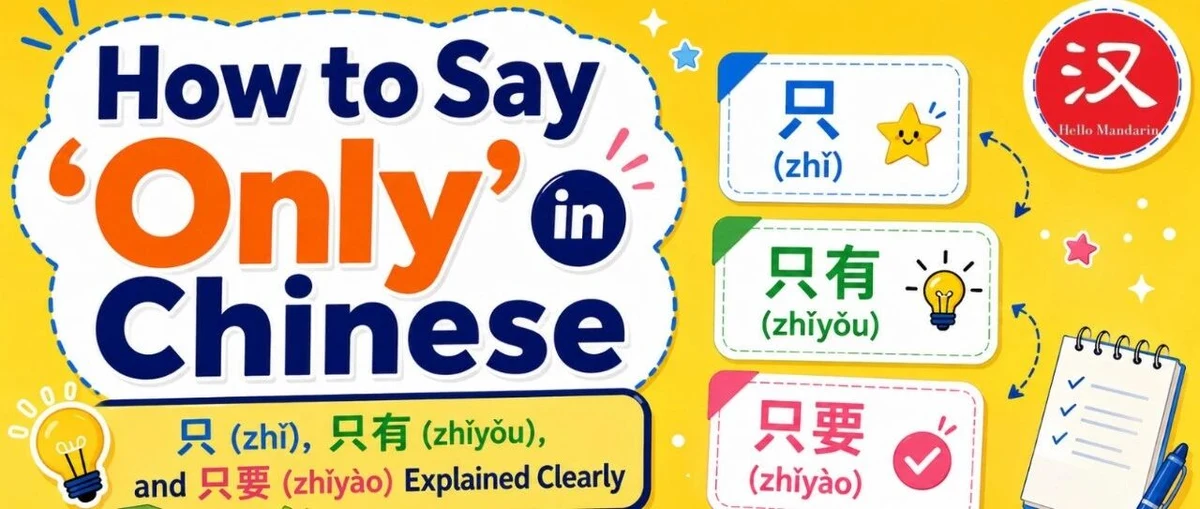
When you want to say “only” in Chinese, one of the most common words is 只(zhǐ).
It looks simple, but many learners make mistakes because they translate English word by word. In Chinese, 只 usually comes before the action, adjective, or phrase it limits.
Let’s learn it in a clear and natural way. 👇
1. The basic meaning of 只(zhǐ)
只 means:
only / just / merely
It tells us that something is limited.
Examples
我只喝咖啡,不喝茶。
I only drink coffee. I don’t drink tea.
他只会说一点儿中文。
He can only speak a little Chinese.
今天我只有十分钟。
Today I only have ten minutes.

2. Put 只 before the verb
The most common pattern is:
Subject + 只 + Verb + Object
Examples
我只吃米饭。
I only eat rice.
她只看中文电影。
She only watches Chinese movies.
我们只学了一课。
We only studied one lesson.

✅ Natural Chinese
我只喝水。
Wǒ zhǐ hē shuǐ.
I only drink water.
❌ Not natural
我喝只水。
In Chinese, 只 usually does not go directly before the noun like English “only water.” It usually comes before the verb.
3. 只 + number / amount: only this many
When you want to say “only one,” “only two,” or “only a little,” you can use 只 before the verb, or use it with 有.
Examples
我只买了一个。
I only bought one.
他只学了三个月中文。
He has only studied Chinese for three months.
这个班只有五个学生。
This class has only five students.

When talking about “there is/there are only…,” 只有 is very common and natural.
4. 只有: only have / only there is / only when
只有 is often used when the “only” part is a person, thing, number, time, or condition.
Examples
我只有一个问题。
I have only one question.
这里只有一家超市。
There is only one supermarket here.
只有他知道这个答案。
Only he knows the answer.
A very useful pattern is:
只有……才……
only if / only when… then…
Examples
只有多练习,才能说得更自然。
Only by practicing more can you speak more naturally.
只有周末,我才有时间。
Only on weekends do I have time.
5. 只 can also limit time, place, or people
只 can limit different parts of a sentence, not only verbs.
Time
我只在周末上课。
I have class only on weekends.
Place
他只在家学习。
He studies only at home.
Person
我只跟老师说了这件事。
I told only the teacher about this.

To make the meaning clearer, Chinese often adds contrast:
我只跟老师说了这件事,没跟同学说。
I told only the teacher about this, not my classmates.
6. Be careful: 只要 does not always mean “only want”
This part is important. ⚠️
Sometimes 只要 means “only want”:
我只要一杯水。
I only want a glass of water.
But 只要……就…… is a fixed pattern. It means:
as long as… then…
Examples
只要你努力,中文就会越来越好。
As long as you work hard, your Chinese will get better and better.
只要有时间,我就学习中文。
As long as I have time, I study Chinese.
So remember:
只要 + noun can mean “only want…”
只要……就…… usually means “as long as…”
7. Common learner mistakes
Mistake 1: Putting 只 in the wrong place
❌ 我喝只咖啡。
✅ 我只喝咖啡。
Wǒ zhǐ hē kāfēi.
I only drink coffee.
Mistake 2: Using 只 before a noun directly
❌ 只一个学生来了。
✅ 只有一个学生来了。
Zhǐyǒu yí ge xuésheng lái le.
Only one student came.
For learners, it is safer and more natural to use 只有 before a noun or number.
Mistake 3: Confusing 只(zhǐ) and 只(zhī)
Be careful with the pronunciation.
只(zhǐ) = only
我只有一个朋友。
Wǒ zhǐ yǒu yí ge péngyou.
I only have one friend.
只(zhī) = measure word for some animals or one of a pair
一只猫
yì zhī māo
one cat
Same character, different tone, different meaning.
8. Quick summary
Use 只(zhǐ) when you want to express only / just / merely.
The most common structure is:
Subject + 只 + Verb + Object
For nouns, numbers, or “there is only…,” use:
只有 + noun / number / person
For “only when / only if,” use:
只有……才……
For “as long as,” use:
只要……就……
Final examples for review
我只想学实用的中文。
I only want to learn practical Chinese.
他只认识十个汉字。
He only knows ten Chinese characters.
我们只有一个小时。
We have only one hour.
只有多说,才能说得更流利。
Only by speaking more can you speak more fluently.
Learning 只 is not difficult, but word order matters. Once you understand where to put it, your Chinese will sound much more natural. 🌱