
Have you ever heard someone ask a question in Chinese, but they didn’t seem to want an answer?
For example:
谁不喜欢周末呢?
Who doesn’t love weekends?
The speaker isn’t really asking you to name someone who dislikes weekends.
They’re saying that weekends are great!
This is called 反问句 (fǎnwènjù) — a rhetorical question.
Instead of asking for information, rhetorical questions often express an opinion, emphasize a point, or show how someone feels.
Let’s look at four common patterns you’ll hear in everyday Chinese.
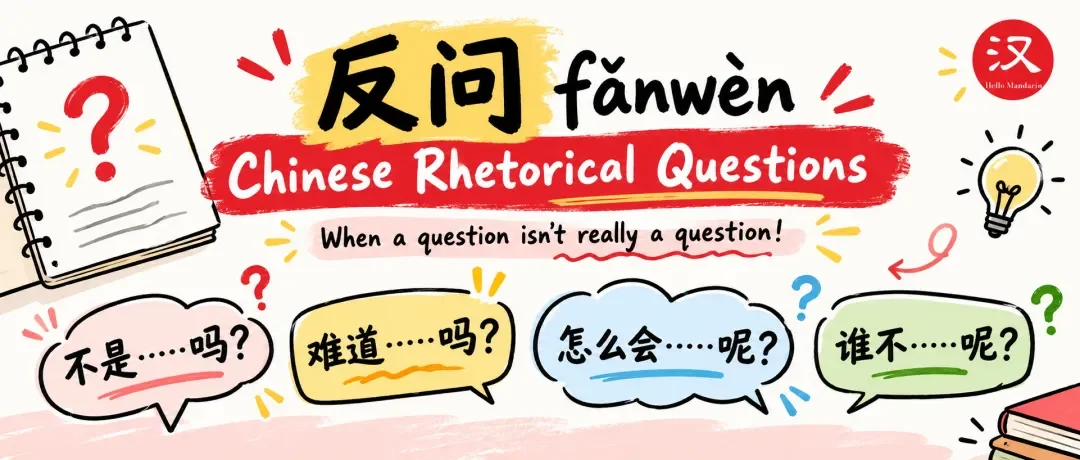
① 不是……吗? — Didn’t You…? / Isn’t It…?
We often use 不是……吗? to remind someone of something they said or to emphasize something that seems obvious.
Example 1
你不是说今天有空吗?
Didn’t you say you were free today?
👉 The speaker remembers what you said earlier and may be wondering why things have changed.
Example 2
我们不是说好七点见面吗?
Didn’t we agree to meet at seven?
👉 The speaker is reminding someone of an earlier agreement.
Example 3
这不是很好吗?
Isn’t that a good thing?
👉 The speaker thinks the situation is positive.
💡 Remember: Not every 不是……吗? sentence is rhetorical. Sometimes the speaker really is checking something. Context and tone make the difference.

② 难道……吗? — Are You Seriously…?
难道 (nándào) adds surprise, disbelief, or a stronger sense of challenge.
It’s useful when you find something hard to believe or disagree with what is happening.
Example 1
这么晚了,难道你不累吗?
It’s so late. Aren’t you tired?
👉 The speaker expects you to be tired and is surprised that you don’t seem to be.
Example 2
难道我们现在就放弃吗?
Are we really going to give up now?
👉 The speaker doesn’t think they should give up.
Compare:
我们现在就放弃吗?
Are we giving up now?
难道我们现在就放弃吗?
Are we seriously giving up now?
See the difference?
Adding 难道 makes the speaker’s attitude much stronger.
⚠️ Tone matters! 难道 can sound like you’re challenging someone, especially during an argument. Use it carefully.

③ 怎么会……呢? — How Could…?
In a rhetorical question, 怎么会……呢? often expresses disbelief.
The speaker is suggesting that something is impossible, unlikely, or hard to imagine.
Example 1
他没告诉我,我怎么会知道呢?
He didn’t tell me. How was I supposed to know?
👉 The speaker means: I had no way of knowing!
Example 2
我怎么会不记得你的生日呢?
How could I forget your birthday?
👉 The speaker means: Of course I remember your birthday!
Notice something interesting:
-
怎么会知道呢? — How could I know? (I don’t know.)
-
怎么会不记得呢? — How could I not remember? (Of course I remember!)
💡 Be careful: Not every question with 怎么 is rhetorical.
你怎么来的?
How did you get here?
This is a normal question. The speaker genuinely wants to know how you arrived.

④ 谁不……呢? — Who Wouldn’t…?
This is one of the easiest rhetorical patterns to recognize.
We often use 谁不……呢? when talking about something we think most people would want or agree with.
Example 1
谁不想早点回家呢?
Who wouldn’t want to get home early?
👉 The speaker assumes that most people would like to go home early.
Example 2
谁不想省点钱呢?
Who wouldn’t want to save a little money?
👉 The speaker thinks saving money is something most people would appreciate.
In both examples, 谁不……呢? emphasizes a feeling that the speaker considers widely shared.
It doesn’t necessarily mean that every single person feels that way.

💬 Why Does Tone Matter So Much?
A rhetorical question can sound friendly, encouraging, surprised, or even annoyed.
Imagine someone says:
你不是说今天有空吗?
Didn’t you say you were free today?
🙂 With a curious tone, it may simply be a request for clarification.
😠 With an annoyed tone, it may sound like a complaint.

Same sentence. Different feeling.
That’s why understanding rhetorical questions isn’t just about memorizing grammar. It’s also about listening to how people speak.
🎯 Quick Practice!
Read these two sentences. What does the speaker really mean?
1. 我怎么会不开心呢?
Wǒ zěnme huì bù kāixīn ne?
How could I not be happy?
Does the speaker mean they’re happy or unhappy?
2. 谁不想多休息一天呢?
Shéi bù xiǎng duō xiūxi yì tiān ne?
Who wouldn’t want an extra day off?
Does the speaker think people would like another day off?
✅ Answers
1. The speaker is happy!
2. Yes! The speaker assumes most people would love an extra day off.
🌟 The Takeaway
The next time you hear a question in Chinese, don’t just think about what the words mean.
Think about why someone is asking it.
-
不是……吗? — Often reminds someone of something.
-
难道……吗? — Adds surprise, disbelief, or a challenge.
-
怎么会……呢? — Often expresses disbelief.
-
谁不……呢? — Emphasizes a feeling the speaker thinks is widely shared.
You don’t need to use all four patterns right away.
Start by recognizing them in conversations, Chinese videos, or TV shows. Once you get used to them, you’ll understand much more of the feeling behind everyday Chinese.
💬 Your turn: Have you heard any of these expressions before? Try making your own 反问句 (fǎnwènjù)!