
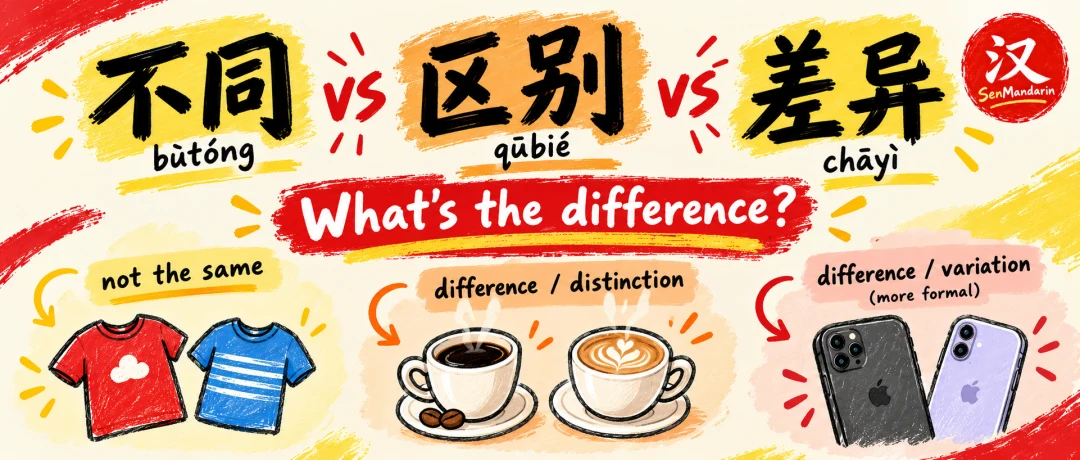
不同、区别、差异 — these three Chinese words are all related to differences.
They may look similar in English, but they’re not always used in the same way.
For example, how would you say:
-
“These two things are different.”
-
“What’s the difference between them?”
-
“There are noticeable differences.”
In Chinese, choosing the right word depends on what you want to express.
Let’s make it simple! 👇
不同 (bùtóng) — Different / Not the Same
Adjective
不同 describes people, things, ideas, or situations that are not the same.
It’s a common word you’ll hear in everyday conversations.
Common Patterns:
A 和 B 不同 — A and B are different.
不同的 + Noun — Different…
Examples
这两件衣服的颜色不同。
These two pieces of clothing are different colors.
我和姐姐的想法不同。
My sister and I have different ideas.
我们喜欢不同的音乐。
We like different kinds of music.
💡 Quick Tip
In everyday conversation, 不一样 (bù yíyàng) is another common way to say “different.”
For example:
我们的想法不一样。
We have different ideas.
Both 不同 and 不一样 work naturally here.

区别 (qūbié) — Difference / Distinction
Noun & Verb
区别 refers to the differences between things. As a verb, it can also mean “to distinguish” or “to treat differently.”
You’ll often use it when comparing two things or asking how they’re different.
As a noun: A difference
Common Patterns:
A 和 B 的区别 — The difference between A and B
有什么区别? — What’s the difference?
Examples
这两个词有什么区别?
What’s the difference between these two words?
这两种咖啡有什么区别?
What’s the difference between these two types of coffee?
As a verb: To distinguish / Treat differently
不同的情况要区别对待。
Different situations should be handled differently.
Here, 区别对待 (qūbié duìdài) means “to treat differently.”
💡 Quick Tip
You can also ask:
这两个词有什么不同?
What’s different about these two words?
Both 有什么区别? and 有什么不同? are natural.
When you specifically mean “to tell two things apart,” 区分 (qūfēn) is often a more natural verb in everyday Chinese.

差异 (chāyì) — Difference / Variation
Noun
差异 refers to differences or variations between things, people, or situations.
It’s often used in more formal conversations, articles, reports, and discussions.
You’ll commonly see it when talking about cultural differences, prices, habits, or research findings.
Common Expressions:
文化差异 — Cultural differences
明显的差异 — Noticeable differences
存在差异 — Differences exist
差异很大 — Significant differences
Examples
这两家店的价格差异不大。
There’s not much difference in price between these two shops.
不同国家的饮食习惯存在差异。
Eating habits vary from country to country.
这两款手机的功能有明显差异。
There are noticeable differences in the features of these two phones.
💡 Quick Tip
差异 doesn’t necessarily mean a big difference.
You can say:
差异很大 — The differences are significant.
差异不大 — The differences are small.
And although 差异 sounds more formal, it isn’t limited to academic writing.

Same Situation, Three Different Expressions
Imagine you’re shopping for a new phone. 📱
You see two models and want to compare them.
Here’s how the three words work:
这两款手机的颜色不同。
These two phone models come in different colors.
→ 不同 simply describes something that isn’t the same.
这两款手机有什么区别?
What’s the difference between these two phones?
→ 区别 asks how the two phones differ.
这两款手机的价格差异很大。
There’s a big price difference between these two phones.
→ 差异 describes a particular difference, with a slightly more formal tone.
All three sentences are correct, but each focuses on a different aspect of the comparison.
One Common Mistake
Remember: 不同 is generally an adjective, while 区别 and 差异 can function as nouns.
Compare:
❌ 这两件衣服很区别。
✅ 这两件衣服不同。
These two pieces of clothing are different.
✅ 这两件衣服有很大区别。
There’s a big difference between these two pieces of clothing.
Why?
In this sentence, you can use 不同 directly to describe the clothes.
But 区别 is a noun in the pattern 有 + 区别.
Another useful point: 区别 and 差异 can sometimes be used in the same sentence.
For example:
有明显区别 — There are noticeable differences.
有明显差异 — There are noticeable differences.
Both are correct. 差异 usually sounds a little more formal or analytical.
Quick Review
Here’s the easiest way to remember these three words:
不同 (bùtóng)
→ “They are different.”
Use it to describe things that aren’t the same.
区别 (qūbié)
→ “What’s the difference?”
Use it to ask about or identify differences. It can also be a verb.
差异 (chāyì)
→ “There are differences or variations.”
Use it when discussing differences, especially in more formal contexts.
Remember: These are common usage patterns, not absolute rules. The words overlap in meaning, but their grammar and typical contexts aren’t always the same.
Mini Practice!
Choose the most natural word for each sentence.
不同 / 区别 / 差异
1. 我和朋友的爱好 ______。
My friend and I have different hobbies.
2. 这两个汉字有什么 ______?
What’s the difference between these two Chinese characters?
3. 研究发现,这两组学生的学习习惯存在明显 ______。
The study found noticeable differences in the study habits of the two groups.
✅ Answers
1. 不同 — Describing different hobbies.
2. 区别 — Asking what makes two characters different. 不同 is also natural here.
3. 差异 — A natural choice in a research context. 区别 is also possible; the sentence does not have only one grammatically correct answer.
Final Tip
You don’t need to memorize complicated rules.
Start with these three ideas:
不同 → Something is different.
区别 → What makes it different?
差异 → Differences or variations, often discussed more formally.
Once you recognize these patterns, choosing the right word becomes much easier.
Your turn! 😊
Can you write a sentence using 不同、区别, or 差异?