
Have you ever wondered why some Chinese words describe people, some express actions, and others connect different parts of a sentence?
Understanding parts of speech is an important step in learning Chinese. It helps you understand how sentences are built, where words should appear, and how to express your ideas more naturally.
In Chinese, parts of speech are called 词类 (cílèi).
Different grammar books may organize some word classes slightly differently. In this article, we’ll focus on the common categories and the ones you need to understand when learning Chinese.
Let’s get started! 🌱
First, What’s the Difference Between Word Classes and Sentence Parts?
Before learning the different parts of speech, there is one important distinction to understand.
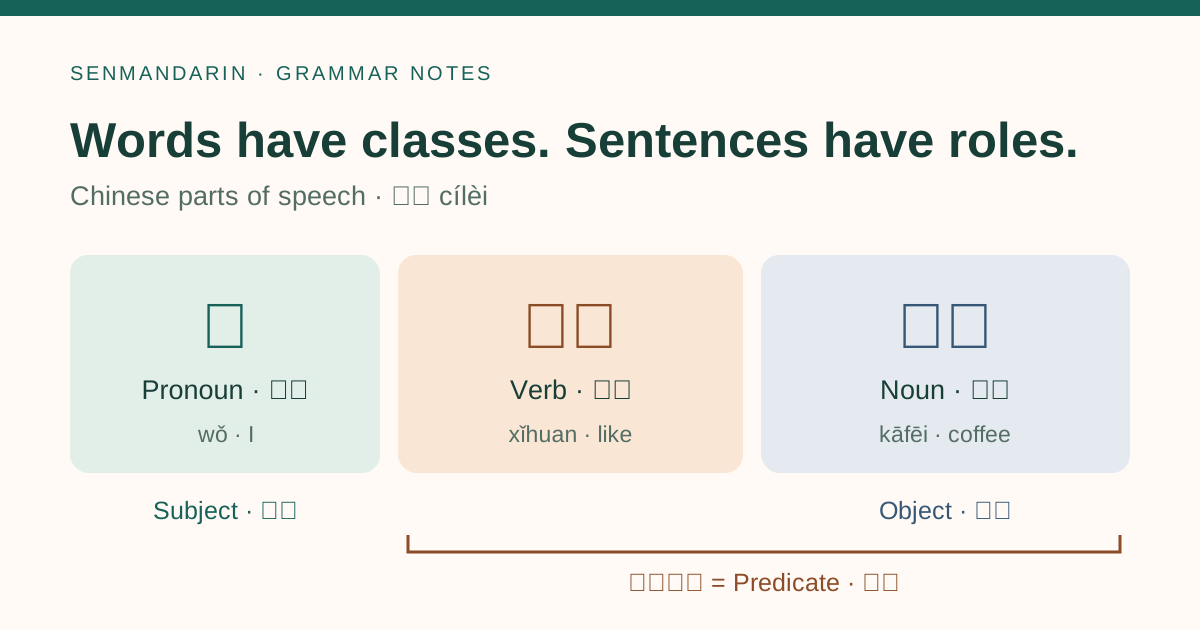
Parts of speech tell us what kind of word something is.
Sentence parts tell us what role that word plays in a sentence.
For example:
我喜欢咖啡。
I like coffee.
- 我 – Pronoun (代词): Subject (主语)
- 喜欢 – Verb (动词): The main verb in the predicate (谓语)
- 咖啡 – Noun (名词): Object (宾语)
The full predicate is 喜欢咖啡 (like coffee). It includes the verb 喜欢 and its object 咖啡.
So, a word can be a noun, but its role in a sentence might be the subject or the object.
Keep this distinction in mind as you continue!
1. Nouns – 名词 (míngcí)
Nouns are words used to name people, places, things, and concepts.
They answer questions such as Who? or What?
Common examples:
- 人 (rén) – person
- 学生 (xuésheng) – student
- 老师 (lǎoshī) – teacher
- 学校 (xuéxiào) – school
- 书 (shū) – book
- 时间 (shíjiān) – time
- 朋友 (péngyou) – friend
Examples:
我是学生。
I am a student.
桌子上有一本书。
There is a book on the table.
Remember:
Chinese nouns generally do not change their form to show singular or plural.
The particle 们 (men) can be added to personal pronouns and some nouns referring to people.
- 我 → 我们 (we)
- 学生 → 学生们 (students)
- 老师 → 老师们 (teachers)
However, 们 is not normally used after a number and a measure word.
✅ 三个学生 (three students)
❌ 三个学生们
2. Pronouns – 代词 (dàicí)
Pronouns are words used to refer to people, things, places, or other information without repeating their names.
Common examples:
Personal pronouns (人称代词):
- 我 (wǒ) – I / me
- 你 (nǐ) – you
- 他 (tā) – he / him
- 她 (tā) – she / her
- 它 (tā) – it
- 我们 (wǒmen) – we / us
Demonstrative pronouns (指示代词):
- 这 (zhè) – this
- 那 (nà) – that
Interrogative pronouns (疑问代词):
- 谁 (shéi) – who
- 什么 (shénme) – what
- 哪 (nǎ) – which
Examples:
她是我的老师。
She is my teacher.
你在找什么?
What are you looking for?
Remember: 他、她、它 are all pronounced tā, but they have different written forms and uses.
3. Verbs – 动词 (dòngcí)
Verbs express actions, activities, events, or states.
They tell us what someone does or what happens.
Common examples:
- 吃 (chī) – to eat
- 喝 (hē) – to drink
- 学习 (xuéxí) – to study
- 工作 (gōngzuò) – to work
- 喜欢 (xǐhuan) – to like
- 认识 (rènshi) – to know / be acquainted with
- 休息 (xiūxi) – to rest
Examples:
我每天学习汉语。
I study Chinese every day.
他喜欢喝咖啡。
He likes drinking coffee.
What about modal verbs?
Some verbs express ability, possibility, permission, intention, or necessity. These are called modal verbs (能愿动词).
Common examples:
- 会 (huì) – can / know how to
- 能 (néng) – can / be able to
- 可以 (kěyǐ) – may / can
- 应该 (yīnggāi) – should
They usually appear before another verb.
我会说一点儿汉语。
I can speak a little Chinese.
Remember: Chinese verbs do not change their forms according to the subject or tense as English verbs do. Time expressions and grammatical markers help show when an action happens.
4. Adjectives – 形容词 (xíngróngcí)
Adjectives describe the qualities, characteristics, or conditions of people and things.
Common examples:
- 大 (dà) – big
- 小 (xiǎo) – small
- 漂亮 (piàoliang) – beautiful
- 忙 (máng) – busy
- 高兴 (gāoxìng) – happy
- 重要 (zhòngyào) – important
- 方便 (fāngbiàn) – convenient
Examples:
今天天气很冷。
It’s cold today.
她买了一件漂亮的衣服。
She bought a beautiful piece of clothing.
An important grammar point!
Unlike English, Chinese adjectives can directly function as the predicate of a sentence.
You usually don’t need 是 (shì) before an adjective.
✅ 他很高。
He is tall.
Not a neutral description: 他是很高。
For a neutral description, use 他很高. The version with 是 can be grammatical when emphasizing or conceding a point, as in 他是很高,但是打篮球打得不太好 (He is tall, but he does not play basketball very well). It is not the ordinary pattern for introducing a simple adjective predicate.
Also, 很 (hěn) does not always mean “very”. In many ordinary descriptive sentences, it simply helps form a natural adjective predicate.
5. Numerals – 数词 (shùcí)
Numerals express numbers and quantities.
Common examples:
- 一 (yī) – one
- 二 (èr) – two
- 两 (liǎng) – two
- 三 (sān) – three
- 十 (shí) – ten
- 二十 (èrshí) – twenty
- 第一 (dì-yī) – first
Examples:
我有两个哥哥。
I have two older brothers.
这是第二课。
This is Lesson Two.
二 (èr) vs 两 (liǎng)
This is a common source of confusion for Chinese learners.
两 (liǎng) is commonly used before measure words when expressing a quantity.
- 两个人 – two people
- 两本书 – two books
- 两杯咖啡 – two cups of coffee
二 (èr) is commonly used in numbers, counting, and ordinal numbers.
- 二十 – twenty
- 第二 – second
- 二年级 – second grade
Compare:
我有两本书。
I have two books.
他住在二楼。
He lives on the second floor.
6. Measure Words – 量词 (liàngcí)
Measure words are used when counting or identifying quantities of people and things.
They are an important feature of Chinese grammar.
Common examples:
- 个 (gè; often unstressed ge in counting phrases) – general measure word
- 本 (běn) – for books
- 张 (zhāng) – for flat objects
- 只 (zhī) – for many animals and certain paired objects
- 杯 (bēi) – for cups or glasses of drinks
- 件 (jiàn) – for clothing and certain matters
Two common structures
1. Number + Measure Word + Noun
我买了三本书。
I bought three books.
2. Demonstrative + Measure Word + Noun
这本书很有意思。
This book is very interesting.
More examples:
- 一个学生 – one student
- 两张照片 – two photos
- 三杯水 – three glasses of water
- 这件衣服 – this piece of clothing
- 那个人 – that person
Measure words can also count actions!
Some measure words are used with verbs rather than nouns. These are called verbal measure words (动量词).
For example:
- 次 (cì) – times / occasions
- 遍 (biàn) – a complete time from beginning to end
我去过北京两次。
I’ve been to Beijing twice.
7. Adverbs – 副词 (fùcí)
Adverbs modify verbs, adjectives, or sometimes an entire sentence.
They can express frequency, degree, time, negation, and other meanings.
Common examples:
- 很 (hěn) – very
- 非常 (fēicháng) – very / extremely
- 常常 (chángcháng) – often
- 已经 (yǐjīng) – already
- 也 (yě) – also
- 都 (dōu) – all / both
- 不 (bù) – not
- 没 (méi) – not / have not
Examples:
我常常去图书馆。
I often go to the library.
他非常喜欢中国文化。
He likes Chinese culture very much.
不 (bù) vs 没 (méi)
Both express negation, but they are used differently.
不 (bù) is commonly used for habits, intentions, general situations, and future actions.
我不喝咖啡。
I don’t drink coffee.
没 (méi) or 没有 (méiyǒu) commonly negates an action that has not happened or did not happen. 没有 also negates possession or existence, as in 我没有车 (I do not have a car). The choice is not simply “不 for the present, 没 for the past.”
我昨天没喝咖啡。
I didn’t drink coffee yesterday.
Remember: Adverbs usually appear before the verb or adjective they modify.
8. Prepositions – 介词 (jiècí)
Prepositions introduce phrases that express relationships such as location, direction, time, purpose, or the person involved in an action.
Common examples:
- 在 (zài) – at / in
- 从 (cóng) – from
- 对 (duì) – toward / to
- 跟 (gēn) – with
- 给 (gěi) – to / for
- 为了 (wèile) – for / in order to
Examples:
我在学校学习汉语。
I study Chinese at school.
他跟朋友一起吃饭。
He eats with his friend.
我从北京来。
I’m from Beijing.
Remember: In these uses, a preposition combines with a noun or pronoun to form a prepositional phrase. Words such as 在 and 给 can also be verbs in other contexts: 我在家 (I am at home) and 我给你一本书 (I give you a book). In many basic Chinese sentences, this phrase appears before the main verb.
For example:
在学校 + 学习汉语
At school + study Chinese.
9. Conjunctions – 连词 (liáncí)
Conjunctions connect words, phrases, or clauses. They help us express relationships between ideas.
Common examples:
- 和 (hé) – and
- 但是 (dànshì) – but
- 因为 (yīnwèi) – because
- 所以 (suǒyǐ) – so / therefore
- 如果 (rúguǒ) – if
- 虽然 (suīrán) – although
Examples:
我喜欢茶和咖啡。
I like tea and coffee.
我想去旅行,但是没有时间。
I want to travel, but I don’t have time.
因为今天下雨,所以我们不出去。
Because it’s raining today, we’re not going out.
Remember:
- 和 commonly connects nouns or noun phrases.
- 但是 connects contrasting ideas.
- 因为……所以…… connects clauses to express a reason and a result.
10. Particles – 助词 (zhùcí)
Particles are grammatical words that help express relationships, aspect, and the speaker’s attitude.
They usually do not have a complete meaning on their own.
There are several important types.
A. Structural Particles – 结构助词
的 (de) connects a modifier to a noun.
这是我的书。
This is my book.
地 (de) connects an adverbial modifier to a verb.
他认真地学习汉语。
He studies Chinese diligently.
得 (de) follows a verb or adjective to introduce a descriptive complement. In the example below, it describes how well the action is performed. Do not confuse this with a simple result complement such as 看懂 (to read and understand), which does not use 得 in its affirmative form.
他说汉语说得很好。
He speaks Chinese very well.
A simple way to remember:
- 的 + Noun
- 地 + Verb
- Verb / Adjective + 得 + Descriptive complement
B. Aspect Particles – 动态助词
Three important aspect particles are:
- Verb-following 了 (le) – presents an event as a whole (perfective aspect), often understood as a completed event
- 着 (zhe) – marks a continuing state or an accompanying action; it is not simply an equivalent of English “-ing”
- 过 (guo) – indicates a past experience
Examples:
我买了一本书。
I bought a book.
门开着。
The door is open.
我去过北京。
I’ve been to Beijing.
Important: 了 does not simply mean past tense. Its meaning depends on its position and the context.
Compare:
我买了一本书。
The particle 了 follows the verb and presents buying one book as a bounded event. It does not itself specify past tense.
天气冷了。
It has turned cold / It is cold now.
Here, sentence-final 了 indicates a change in the situation. This sentence-final use is commonly distinguished from the verb-following aspect particle; it is included here for comparison.
C. Sentence-final Particles – 语气词
These particles often appear at the end of a sentence to express a question, suggestion, or tone.
Common examples:
- 吗 (ma) – yes-or-no question
- 呢 (ne) – often used to ask about someone or something in return
- 吧 (ba) – often used for suggestions or a softer tone
Examples:
你是学生吗?
Are you a student?
你呢?
What about you?
我们走吧。
Let’s go.
Some grammar books classify 语气词 separately from other 助词. Here, they are introduced together to make the basic functions easier to understand.
11. Interjections and Onomatopoeia – 叹词 (tàncí) and 拟声词 (nǐshēngcí)
These two types of words make everyday Chinese more expressive.
A. Interjections – 叹词
Interjections express emotions, reactions, or calls.
Common examples:
- 哇 (wā) – wow!
- 哎呀 (āiyā) – oh! / oh dear!
- 啊 (a) – an exclamation whose meaning depends on context and intonation
哇,这里真漂亮!
Wow, it’s beautiful here!
B. Onomatopoeia – 拟声词
Onomatopoeia imitates sounds from the real world.
Common examples:
- 叮咚 (dīngdōng) – ding-dong
- 汪汪 (wāngwāng) – woof-woof
- 咚咚 (dōngdōng) – thump-thump / knock-knock
门铃叮咚响了。
The doorbell went ding-dong.
小狗汪汪叫。
The dog is barking.
3 Important Things to Remember
Now that you know the main word classes, here are three important features of Chinese grammar.
1. Chinese verbs do not change according to the subject.
In English, we say:
- I like coffee.
- She likes coffee.
But in Chinese, the verb remains the same.
我喜欢咖啡。
I like coffee.
她喜欢咖啡。
She likes coffee.
2. Word order is very important.
Chinese relies heavily on word order to express grammatical relationships.
Compare:
我喜欢他。
I like him.
他喜欢我。
He likes me.
The same words have different meanings because their positions have changed.
3. One word can have different parts of speech.
Some Chinese words can function as different parts of speech depending on how they are used.
For example, 工作 (gōngzuò):
我在学校工作。
I work at a school.
Here, 工作 is a verb.
我的工作很有意思。
My job is interesting.
Here, 工作 is a noun.
This is why understanding a word in its sentence context is more important than simply memorizing its English translation.
📝 Quick Practice: Can You Identify the Parts of Speech?
Try identifying the bold words in the following sentences.
1. 我每天喝水。
I drink water every day.
2. 她买了一件漂亮的衣服。
She bought a beautiful piece of clothing.
3. 桌子上有三本书。
There are three books on the table.
4. 我常常看中文电影。
I often watch Chinese movies.
5. 我喜欢苹果和香蕉。
I like apples and bananas.
6. 你是学生吗?
Are you a student?
Answers
- 喝 – Verb (动词)
- 漂亮 – Adjective (形容词)
- 三 – Numeral (数词)
- 常常 – Adverb (副词)
- 和 – Conjunction (连词)
- 吗 – Sentence-final particle (语气词)
🎯 Final Tip
Learning Chinese grammar is not just about memorizing definitions. The most important thing is understanding how words work together in a sentence.
When you learn a new Chinese word, try asking yourself:
- What part of speech is it?
- Where does it usually appear in a sentence?
- What other words can it be used with?
- Can it have more than one grammatical function?
The more you practice identifying parts of speech in real sentences, the more naturally you will understand Chinese grammar and build your own sentences.
Keep learning, keep practicing, and enjoy your Chinese journey! 🌱