
NEW HSK 5 / OLD HSK 5–6 | Upper-Intermediate
📢 Your exam results are announced. A company unveils a new phone. Someone posts a video online.
In Chinese, you might hear two words in these situations:
公布 (gōngbù) and 发布 (fābù).
Both can mean “announce” or “make public,” but they’re not always used in the same way.
Let’s look at the difference!
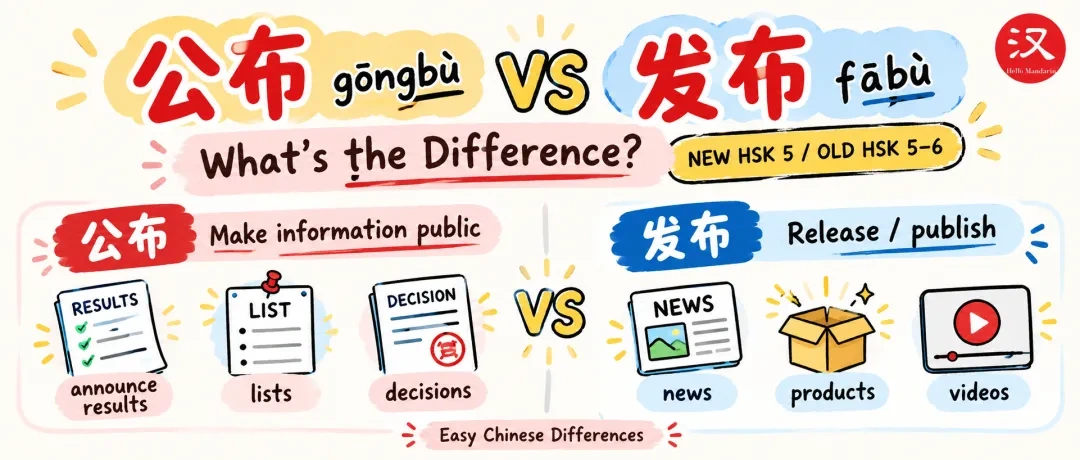
1. 公布 (gōngbù) — To Announce or Make Public
公布 (verb) means to make information known to the public.
It’s often used for results, lists, decisions, and important information.
💡 Think: People can now find out the information.
Common Expressions
-
公布结果 (gōngbù jiéguǒ) — announce the results
-
公布成绩 (gōngbù chéngjì) — announce exam results
-
公布名单 (gōngbù míngdān) — announce a list of names
Examples
① 学校已经公布了考试成绩。
The school has announced the exam results.
② 比赛结果明天公布。
The competition results will be announced tomorrow.
③ 学校公布了参加比赛的学生名单。
The school announced the list of students taking part in the competition.
✅ Remember: When results or information become publicly known, 公布 is often a natural choice.

2. 发布 (fābù) — To Release, Issue, or Publish
发布 (verb) means to release, issue, or publish something for an audience.
It’s commonly used for news, official notices, products, and online content.
💡 Think: Something is being released or shared publicly.
Common Expressions
-
发布消息 (fābù xiāoxi) — release news or an update
-
发布通知 (fābù tōngzhī) — issue a notice
-
发布新产品 (fābù xīn chǎnpǐn) — unveil or launch a new product
-
发布视频 (fābù shìpín) — publish or post a video
Examples
① 公司今天发布了一款新手机。
The company unveiled a new smartphone today.
② 学校发布了新的通知。
The school issued a new notice.
③ 她昨天在网上发布了一段视频。
She posted a video online yesterday.
✅ Remember: 发布 is often used when organizations or individuals release information, products, or content to the public.

\
💬 A Useful Spoken Chinese Tip
When talking about social media, 发 (fā) often sounds more casual than 发布 (fābù).
For example:
我刚发了一个视频。
I just posted a video.
Both 发视频 and 发布视频 are natural, but 发视频 is especially common in everyday conversation.
3. Can 公布 and 发布 Be Used Interchangeably? 🤔
Sometimes, yes!
Look at these two sentences:
① 学校公布了新的考试安排。
The school announced the new exam arrangements.
👉 公布 emphasizes making the information known.
② 学校发布了新的考试安排。
The school released the new exam arrangements.
👉 发布 emphasizes issuing or releasing the information.
Both sentences are natural and have very similar meanings.
The difference is mainly about what you’re emphasizing.
Don’t worry about finding a completely different English translation every time. In many situations, both words can simply mean “announce.”
4. Common Mistake: Choosing the Wrong Verb
When you’re talking about posting a video online, 发布 is a much better choice than 公布.
❌ 我公布了一个新视频。
✅ 我发布了一个新视频。
I posted a new video.
Why?
Because you’re publishing content, not announcing information such as exam results or a list of names.
On the other hand, when talking about exam results, 公布成绩 is the more familiar expression.
📌 A quick way to remember:
-
Exam results or a list of names? → 公布
-
A new product or social media post? → 发布
-
Official information or announcements? → Both may work, depending on the context.
5. Quick Practice ✍️
Choose 公布 or 发布.
① 学校明天会 ______ 考试结果。
The school will announce the exam results tomorrow.
② 公司准备 ______ 一款新手机。
The company is preparing to unveil a new smartphone.
③ 我刚在网上 ______ 了一段视频。
I just posted a video online.
④ 学校 ______ 了新的考试安排。
The school announced the new exam arrangements.
✅ Answers
① 公布 (gōngbù)
② 发布 (fābù)
③ 发布 (fābù)
④ Both are correct!
For ④, 公布 emphasizes making the arrangements known, while 发布 emphasizes releasing the information.
6. One Last Thing to Remember
公布 (gōngbù) → Make information public.
Think: results, lists, decisions.
发布 (fābù) → Release or publish something.
Think: news, products, videos.
The two words sometimes overlap, but learning their common combinations will help you choose more naturally.
💬 Your Turn!
How would you say this in Chinese?
“The exam results will be announced tomorrow.”
Try using 公布 in your answer!
Keep learning Chinese, one useful expression at a time!
— SenMandarin