
You probably learned 好 (hǎo) in your first Chinese lesson.
你好!
Hello!
But 好 doesn’t always mean “good.”
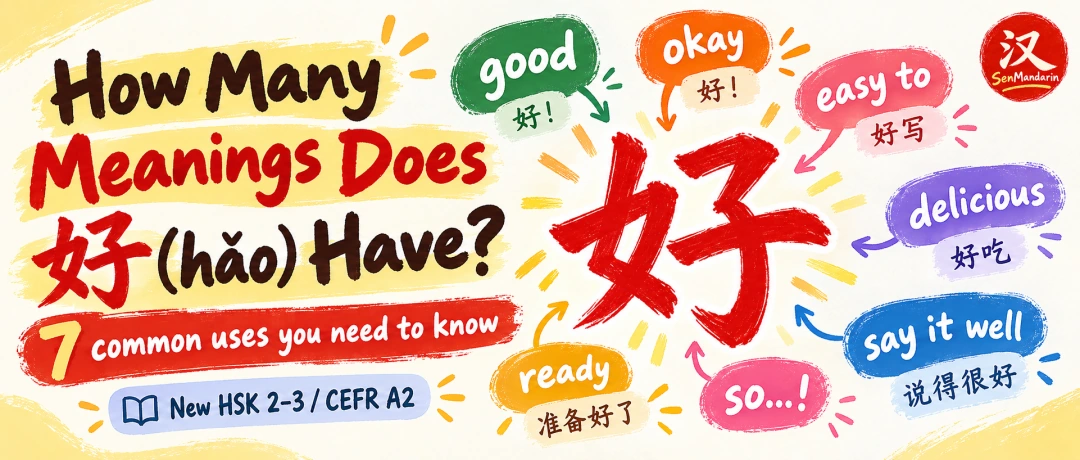
It can also mean well, okay, easy to, enjoyable, ready, or even “so!”
The meaning depends on where 好 appears in a sentence.
Here are seven common ways to use it in everyday Chinese!
1. 好 = Good / Nice 👍
This is the meaning most Chinese learners already know.
We use 好 (hǎo) to describe a person, thing, or situation positively.
Common Patterns:
-
好 + Noun
-
Subject + 很好
Examples:
① 今天天气很好。
The weather is nice today.
② 他是一个好老师。
He’s a good teacher.
③ 我今天感觉不太好。
I’m not feeling very well today.
💡 Remember:
Here, 好 can describe someone’s qualities or condition, or how good something is.
In a neutral statement, 很好 doesn’t always mean “very good.” Sometimes, “good” or “fine” is a more natural translation.

2. 好 = Well (Doing Something Well) 🌟
Want to tell someone they did a good job?
Use 得 (de) + 好 after a verb.
Structure:
Subject + Verb + 得 + 很好
Examples:
① 你说得很好!
You said that really well!
② 她唱得很好。
She sings very well.
💡 Grammar Tip:
得 (de) introduces a description of how an action is performed.
Compare:
她很好。
She’s fine.
她唱得很好。
She sings very well.
The first sentence describes her condition. The second describes how well she sings.

3. 好 = Okay / Sure! ✅
You’ll hear this use of 好 all the time in Chinese conversations.
When someone makes a suggestion, 好 is a natural way to agree.
Conversation 1
A:我们明天见,好吗?
Shall we meet tomorrow?
B:好!
Sure!
Conversation 2
A:我们一起去吃饭吧!
Let’s go eat together!
B:好啊!
Sounds good!
💡 Useful Expressions:
好!(Hǎo!) — Okay! / Sure!
好的!(Hǎo de!) — Okay! / Got it!
好啊!(Hǎo a!) — Sure! / Sounds good!
好吧。(Hǎo ba.) — Alright then.
好吧 can sometimes sound a little reluctant, but not always. Your tone and the situation make a difference.

4. 好 + Verb = Easy to Do ✨
Here’s a useful pattern!
When 好 comes before certain verbs, it can describe something as easy or convenient to do.
Common Pattern:
Something + 很好 / 不好 + Verb
Examples:
① 这个字很好写。
This character is easy to write.
② 这个地方不好找。
This place isn’t easy to find.
More Useful Words:
好写 (hǎo xiě) — easy to write
好找 (hǎo zhǎo) — easy to find
好学 (hǎo xué) — easy to learn
不好做 (bù hǎo zuò) — difficult to do
💡 Important:
This pattern doesn’t work naturally with every verb.
Start by learning common combinations instead of adding 好 to any verb.

5. 好 + Verb = Nice / Enjoyable 😋
Wait a minute!
If 好 + Verb can mean “easy to,” does 好吃 mean “easy to eat”?
Not quite!
Some common 好 + Verb combinations describe something as pleasant or enjoyable.
Examples:
① 这个蛋糕真好吃!
This cake is delicious!
② 这首歌很好听。
This song sounds really nice.
③ 这本书很好看。
This book is a really good read.
💡 Remember These Words:
好吃 (hǎochī) — delicious
好喝 (hǎohē) — tasty (for drinks)
好听 (hǎotīng) — pleasant to hear
好看 (hǎokàn) — good-looking / enjoyable to watch or read
好玩 (hǎowán) — fun
📌 Compare:
好写 (hǎo xiě) — easy to write
好吃 (hǎochī) — delicious
Both begin with 好, but the meaning of the whole expression is different.

6. Verb + 好 = Done / Ready ⏰
Now let’s change the word order!
When 好 comes after a verb, it can show that an action has reached a completed or satisfactory result.
This is called a result complement (结果补语).
Structure:
Verb + 好 + (了)
Examples:
① 饭做好了!
The food is ready!
② 我准备好了。
I’m ready.
③ 我的作业写好了。
I’ve finished writing my homework.
💡 Grammar Tip:
In this pattern, 好 indicates that the action has achieved its intended result.
了 (le) is commonly added to indicate that the new or completed situation has been reached.
Notice the Difference:
好写 (hǎo xiě) — easy to write
写好 (xiě hǎo) — finish writing / write to a satisfactory result
Word order matters!
You can also say:
我还没准备好。
I’m not ready yet.
Here, 没 (méi) tells us the intended result hasn’t been reached.

7. 好 = So / Very! 😮
In casual spoken Chinese, 好 can also express a strong feeling.
It often works like “so” in English.
Structure:
好 + Adjective
Examples:
① 今天好冷啊!
It’s so cold today!
② 这个地方好漂亮!
This place is so beautiful!
③ 我好累啊!
I’m so tired!
💡 Compare:
今天很冷。
It’s cold today.
今天好冷啊!
It’s so cold today!
The first sentence is a neutral description.
The second sounds more expressive. It emphasizes the speaker’s feeling.
You’ll hear this use of 好 quite often in everyday conversations!

🎯 Bonus: 好 Has Another Pronunciation!
There’s one more thing worth knowing.
好 has two common pronunciations:
hǎo — third tone
hào — fourth tone
When pronounced hào, it can express a liking or interest, especially in certain words.
For example:
爱好 (àihào) — hobby / interest
我的爱好是听音乐。
My hobby is listening to music.
📌 Remember:
好 (hǎo) — good, well, okay, etc.
爱好 (àihào) — hobby / interest
Pay attention to the tone when you learn new words!
⭐ Final Review
One Chinese character, seven useful ways to use it!
1. Good / Nice — 好老师 (hǎo lǎoshī)
2. Well — 唱得很好 (chàng de hěn hǎo)
3. Okay / Sure — 好啊!(Hǎo a!)
4. Easy to — 好写 (hǎo xiě)
5. Enjoyable / Pleasant — 好吃 (hǎochī)
6. Done / Ready — 准备好了 (zhǔnbèi hǎo le)
7. So / Very — 好冷啊!(Hǎo lěng a!)
The next time you see 好, look at the words around it.
Is it describing something good? Showing agreement? Or telling you that something is ready?
The sentence will give you the answer.