
📚 Level: NEW HSK 4 / OLD HSK 4 | Intermediate Chinese
You’re meeting a friend at 9:00. You arrive at exactly 9:00.
You finish your homework before the deadline.
Someone reminds you about something important before it’s too late.
In English, we might use “on time” or “in time” to describe these situations. But in Chinese, the choice depends on what you want to emphasize.
Let’s look at three useful words:
-
及时 (jíshí) — in time; promptly
-
准时 (zhǔnshí) — on time; punctual
-
按时 (ànshí) — on schedule; by the required time
They all relate to timing, but there’s a difference! 👇
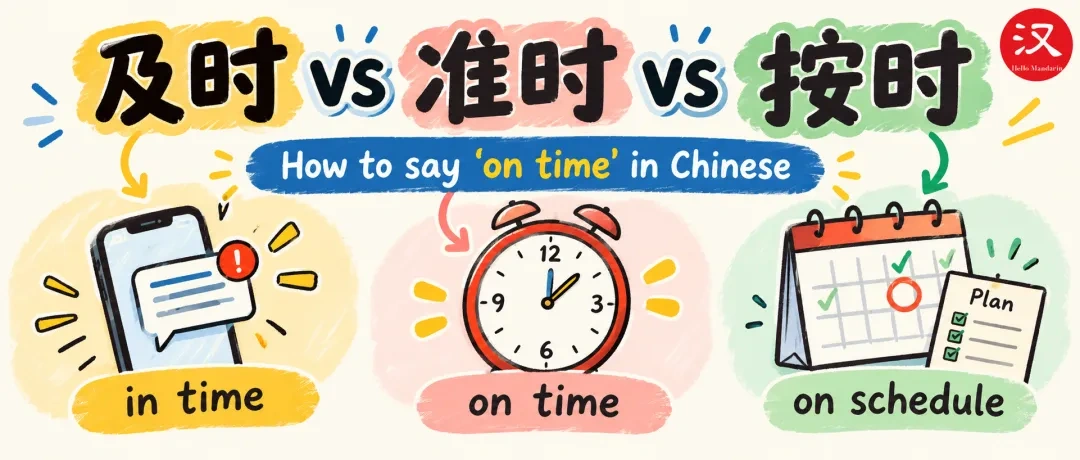
① 及时 (jíshí) — In Time ⏳
Meaning: in time; promptly; when needed
Use 及时 when something happens soon enough or at the right moment.
The important thing isn’t the clock. It’s whether the action happens before it’s too late or without unnecessary delay.
Examples
有问题要及时告诉老师。
If there’s a problem, let your teacher know right away.
谢谢你及时提醒我。
Thanks for reminding me in time.
你来得真及时,我正需要帮忙。
You came at just the right time. I could really use some help.

💡 Think of 及时 as “Don’t wait until it’s too late!”
Common expressions:
-
及时回复 (jíshí huífù) — reply promptly
-
及时发现 (jíshí fāxiàn) — notice something in time
-
及时处理 (jíshí chǔlǐ) — deal with something promptly
② 准时 (zhǔnshí) — On Time ⏰
Meaning: on time; punctual
Use 准时 when something happens at the scheduled or agreed time.
It emphasizes punctuality, especially for meetings, classes, appointments, and transportation.
Examples
会议九点开始,请准时到。
The meeting starts at nine. Please be on time.
火车今天准时到站了。
The train arrived on time today.
你来得真准时,现在正好八点!
You’re right on time! It’s exactly eight!
💡 Think of 准时 as “Be there at the agreed time!”
Common expressions:
-
准时到达 (zhǔnshí dàodá) — arrive on time
-
准时开始 (zhǔnshí kāishǐ) — start on time
-
准时出发 (zhǔnshí chūfā) — leave on time

③ 按时 (ànshí) — On Schedule 📅
Meaning: on schedule; by the required time
Use 按时 when you do something according to a timetable, routine, or deadline.
The focus is on meeting a time requirement, rather than arriving at one exact moment.
Examples
请按时交作业。
Please hand in your homework by the deadline.
记得按时吃药。
Remember to take your medicine at the scheduled times.
我们按时完成了工作。
We finished the work on schedule.
💡 Think of 按时 as “Follow the schedule!”
Here’s something useful:
If your homework is due on Friday and you hand it in on Thursday, you’ve still submitted it 按时.
But 按时吃药 means taking medicine according to the prescribed schedule, not simply taking it as early as possible.
Common expressions:
-
按时完成 (ànshí wánchéng) — finish on schedule
-
按时交作业 (ànshí jiāo zuòyè) — submit homework by the deadline
-
按时吃饭 (ànshí chīfàn) — eat meals at regular times

🔍 Can 准时 and 按时 Be Used Interchangeably?
Sometimes, yes!
Both can describe doing something according to an agreed time.
However, they emphasize different things:
准时 focuses on punctuality.
按时 focuses on following a schedule or meeting a deadline.
For example:
请准时参加会议。
Please be on time for the meeting.
请按时完成工作。
Please finish the work on schedule.
The first sentence emphasizes arriving at the agreed time. The second emphasizes meeting the required completion time.
And what about 及时?
That one’s different!
及时 focuses on acting when it’s needed, even if there’s no fixed schedule.

✨ One Small Grammar Tip
All three words can appear before a verb.
But 准时 and 及时 can also naturally describe how well-timed an action was.
For example:
你来得很准时。
You arrived right on time.
你的提醒很及时。
Your reminder came at just the right time.
Unlike these two words, 按时 is generally used before a verb. We don’t normally say “很按时”.

✏️ Quick Practice!
Choose the best word: 及时 / 准时 / 按时
① 火车今天八点____出发了。
The train left at eight on the dot today.
② 你要____完成这份工作。
You need to finish this work on schedule.
③ 他____发现了问题,所以我们还有时间修改。
He spotted the problem in time, so we still have time to fix it.

✅ Answers
① 准时 — The train left at the scheduled time.
② 按时 — The work needs to be finished according to the required schedule.
③ 及时 — The problem was spotted early enough to fix it.
🎯 Remember the Difference!
及时 (jíshí) = Before it’s too late
准时 (zhǔnshí) = At the scheduled time
按时 (ànshí) = According to the schedule or deadline
Next time you want to say “on time” in Chinese, think about the situation first.
Are you talking about good timing, punctuality, or meeting a deadline?
That’s your clue!