
Discover the New Grammar Topics in the Revised HSK 1 Learning Materials
The revised HSK 1 grammar collection introduces several important topics that help learners understand Chinese more systematically.
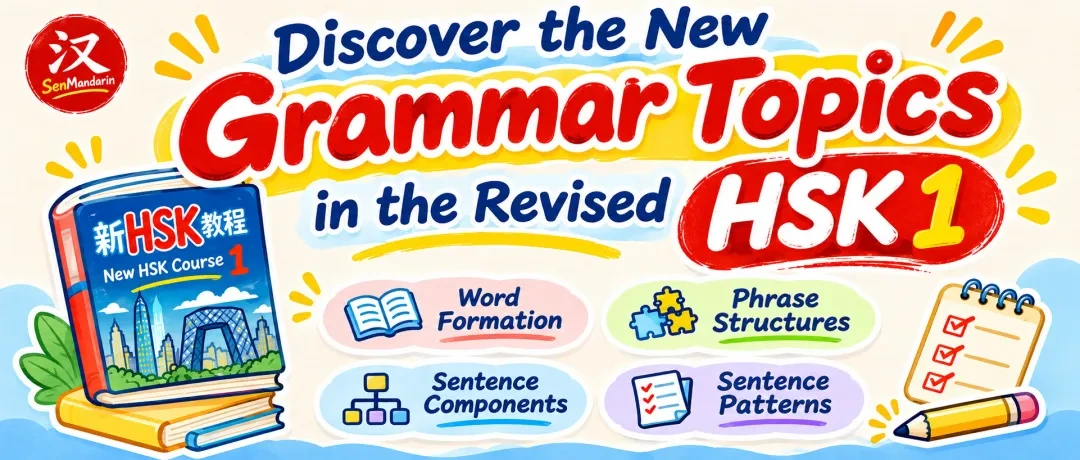
Compared with the previous learning materials, the revised collection places greater emphasis on word formation, phrase structures, sentence components, and more detailed sentence patterns.
In particular, learners will encounter new explanations of separable verbs, locational phrases, A-not-A questions, sentence components, and different types of complex sentences.
Let’s explore the newly introduced and expanded grammar topics.
1. New Word Formation and Word Structures
1. 小 (xiǎo) as a Familiar Prefix and 第 (dì) as an Ordinal Prefix
小 can be used before certain surnames to express familiarity or relative youth.
Examples:
小王来了。
Xiao Wang has arrived.
小李是我的朋友。
Xiao Li is my friend.
第 is used before a number to form ordinal numbers.
Examples:
-
第一 (dì-yī) – first
-
第二 (dì-èr) – second
-
第三个 (dì-sān ge) – the third one
这是我的第一本汉语书。
This is my first Chinese book.
2. Suffixes: 们 (men) and 边 (biān)
The revised materials introduce these suffixes more systematically.
们 indicates a plural or collective meaning when added to personal pronouns and certain nouns referring to people.
Examples:
-
我们 – we
-
你们 – you (plural)
-
老师们 – teachers
-
孩子们 – children
边 is a locative suffix used after directional words to form expressions describing positions.
Examples:
-
上边 – above
-
下边 – below
-
里边 – inside
-
外边 – outside
-
前边 – in front
-
后边 – behind
学校前边有一家书店。
There is a bookstore in front of the school.
3. Locational Nouns (方位名词)
The revised collection introduces locational nouns as an independent grammar topic.
Common examples include:
-
上 (shàng) – above / on
-
下 (xià) – below / under
-
里 (lǐ) – inside
-
外 (wài) – outside
-
前 (qián) – in front
-
后 (hòu) – behind
Basic structure:
Noun / Place + Locational Noun
Examples:
书在桌子上。
The book is on the table.
猫在椅子下。
The cat is under the chair.
学生在教室里。
The students are in the classroom.
4. Separable Verbs (离合词)
Separable verbs are an important new focus.
Some Chinese expressions consist of a verb and an object. Although they function as one lexical unit, other grammatical elements can appear between their two parts.
Common examples:
-
睡觉 – to sleep
-
说话 – to speak
-
上课 – to have class
-
下课 – to finish class
-
上班 – to go to work
-
下班 – to finish work
-
看病 – to see a doctor
-
生病 – to get sick
Examples:
我们上午上了两节课。
We had two classes this morning.
他说了几句话。
He said a few words.
Understanding separable verbs helps learners use aspect markers, quantities, and other grammatical elements correctly.
5. The Collective Pronoun 大家 and Indefinite Expressions 有的 / 有些
The revised materials introduce 大家 as a collective pronoun meaning everyone.
大家好,我是老师。
Hello everyone, I am the teacher.
They also introduce two expressions for referring to an indefinite group or selection:
-
有的 – some / some of them
-
有些 – some / certain
Examples:
有的人喜欢咖啡。
Some people like coffee.
有些菜很好吃。
Some dishes are very tasty.
2. New Modal Verb Comparisons and Adverbial Expressions
6. Modal Verbs: 会 (huì) vs. 能 (néng)
The revised materials provide a clearer comparison between these two modal verbs.
-
会 – ability acquired through learning or practice.
-
能 – ability or possibility based on present conditions.
Examples:
我会说一点儿中文。
I can speak a little Chinese.
我们今天能去公园。
We can go to the park today.
7. Modal Verbs: 想 (xiǎng) vs. 要 (yào)
The revised collection provides a more detailed comparison of these expressions.
-
想 – expresses a wish or intention, usually less direct.
-
要 – can express a desire, intention, or necessity.
Examples:
我想吃米饭。
I want to eat rice.
我要苹果。
I want an apple.
我们明天要上课。
We have class tomorrow.
8. 可以 (kěyǐ): Permission and Possibility
可以 is given a separate explanation, focusing on permission and condition-based possibility.
Examples:
我可以喝水吗?
May I drink water?
小孩子不可以喝咖啡。
Children may not drink coffee.
9. Degree Adverbs: 真 (zhēn) and 有一点儿 (yǒu yìdiǎnr)
The revised materials expand the explanation of degree expressions.
-
真 – really
-
有一点儿 – a little / somewhat
Examples:
她真漂亮。
She is really beautiful.
我有一点儿累。
I am a little tired.
10. Recurrence and Repetition: 再 (zài) and 再也不 (zài yě bù)
再 can express repetition or a subsequent action.
再也不 expresses strong negation, meaning never again.
Examples:
请再说一遍。
Please say it again.
我再也不迟到了。
I will never be late again.
11. Continuation and Addition: 还 (hái)
还 can express continuation or introduce additional information.
Examples:
他还在上班。
He is still at work.
他会唱歌,还会跳舞。
He can sing, and he can also dance.
12. Prohibition with 不要 (búyào)
不要 is explained as a way to express prohibition or unwillingness, depending on context.
Examples:
不要喝咖啡。
Don’t drink coffee.
不要去。
Don’t go.
13. Progressive Meaning with Sentence-Final 呢 (ne)
The revised materials give 呢 a more detailed explanation in progressive constructions.
It can appear after 在 / 正在 + Verb Phrase, or independently when the context makes the ongoing meaning clear.
Examples:
我在吃饭呢。
I am eating right now.
他正在看书呢。
He is reading a book at the moment.
妈妈做饭呢。
Mom is cooking right now.
3. Seven Types of Chinese Phrase Structures
One of the most important additions is the systematic introduction of Chinese phrase structures (短语结构).
The revised collection introduces seven types:
1. Coordinate Phrases (联合短语)
Two or more elements of equal grammatical status are connected.
Example:
老师和学生
Teachers and students.
2. Nominal Modifier-Head Phrases (定中偏正短语)
A modifier describes or limits a noun.
Example:
漂亮的女孩
A beautiful girl.
3. Verb-Object Phrases (动宾短语)
A verb is followed by its object.
Example:
喝水
Drink water.
4. Subject-Predicate Phrases (主谓短语)
A subject is followed by a predicate describing it.
Example:
我很高兴
I am very happy.
5. Quantity Phrases (数量短语)
A numeral is combined with a classifier.
Example:
三本书
Three books.
6. Preposition-Object Phrases (介宾短语)
A preposition is followed by its object.
Example:
在学校
At school.
7. Locational Phrases (方位短语)
A noun or place expression combines with a locational noun.
Example:
桌子上
On the table.
These structures help learners understand how individual words combine to form meaningful Chinese phrases.
5. Chinese Sentence Components (句子成分)
The revised materials introduce the grammatical functions of different sentence components.
1. Subject (主语)
The subject identifies the person or thing being discussed.
Example:
我的书在桌子上。
My book is on the table.
Subject: 我的书
2. Object (宾语)
The object is the person or thing associated with the verb.
Example:
我喜欢苹果。
I like apples.
Object: 苹果
3. Attributive Modifier (定语)
An attributive modifier describes or limits a noun.
It can express ownership, quality, or quantity.
Examples:
-
漂亮的女孩 – a beautiful girl
-
我的书 – my book
-
三个苹果 – three apples
4. Adverbial (状语)
An adverbial modifies a verb, adjective, or predicate by providing information about time, place, manner, degree, or scope.
Examples:
我今天去学校。
I am going to school today.
我们慢慢地走。
We walk slowly.
5. Action-Count Complements (动量补语)
A quantity complement after a verb indicates how many times an action occurs.
Common expressions include:
-
次 (cì) – times / occasions
-
遍 (biàn) – complete repetitions
-
下 (xià) – times / knocks
-
趟 (tàng) – trips
Examples:
我去过北京两次。
I have been to Beijing twice.
他敲了三下门。
He knocked on the door three times.
请再说一遍。
Please say it once more.
6. New Sentence Patterns and Constructions
1. Non-Subject-Predicate Sentences (非主谓句)
Some Chinese sentences function as complete utterances without a subject-predicate structure.
Examples:
请进!
Please come in!
下雨了。
It has started raining.
好!
Okay!
2. A-not-A Questions (正反疑问句)
A-not-A questions present both the affirmative and negative forms of a predicate.
Basic structure:
Subject + Verb / Adjective + 不 + Verb / Adjective
Examples:
你去不去学校?
Are you going to school?
你会不会游泳?
Can you swim?
天气冷不冷?
Is it cold?
Unlike ordinary 吗 questions, A-not-A questions normally do not need 吗.
3. Locative 是 Sentences (处所是字句)
The revised materials introduce a more specific use of 是 in location-related sentences.
Structure:
Location + 是 + Noun Phrase
Example:
门口是接待处。
The reception desk is by the entrance.
This structure identifies or describes what occupies a particular location.
It is important to distinguish it from:
桌子上有一本书。
There is a book on the table.
是 identifies or describes, while 有 introduces existence.
4. Existential Sentences with Quantity Phrases
The revised materials provide a more specific structure for expressing the existence of a certain number of things in a location.
Structure:
Location + 有 + Number + Classifier + Noun
Examples:
桌子上有两本书。
There are two books on the table.
房间里有三只猫。
There are three cats in the room.
5. Serial-Verb Sentences Expressing Purpose (连动句:目的)
Two verb phrases can share the same subject. The second action explains the purpose of the first.
Structure:
Subject + Verb Phrase 1 + Verb Phrase 2 (Purpose)
Examples:
我去图书馆看书。
I am going to the library to read.
他来中国学习汉语。
He came to China to study Chinese.
6. Serial-Verb Sentences Expressing Manner or Means (连动句:方式或手段)
The first verb phrase explains how or by what means the main action is performed.
Examples:
我们坐公共汽车去学校。
We take the bus to school.
他骑自行车去上班。
He rides a bicycle to work.
7. Complex Sentences Without an Overt Conjunction
Chinese sometimes connects two clauses without an explicit conjunction when the relationship is clear from context.
Examples:
天晴了,我们去公园。
The weather has cleared, so let’s go to the park.
你先吃饭,我等你。
You eat first; I’ll wait for you.
The relationship between the clauses is understood from the context.
Why Are These New Grammar Topics Important?
The revised HSK 1 grammar materials help learners move beyond memorizing individual words and simple sentence patterns.
The newly introduced topics provide a foundation for understanding:
-
How Chinese words are formed.
-
How phrases are organized.
-
How different sentence components function.
-
How to ask questions naturally.
-
How to express purpose, manner, and additional information.
-
How to build more complete and meaningful sentences.
For beginners, understanding these structures early can make further Chinese learning much easier.
Editorial Note: This article highlights newly presented or substantially expanded topics in SenMandarin’s revised HSK 1 grammar collection. It is an independent educational comparison, not an official announcement of newly added examination requirements by the HSK examination authority.