
NEW HSK2–3 / Old HSK3 (A2)
Imagine you’re learning Chinese and you’ve just learned two basic words:
-
上 (shàng) – up
-
下 (xià) – down
Then one day, you hear a Chinese person say:
我要上厕所。
I need to use the restroom.
Wait a minute! If 上 means “up”, why don’t Chinese people say 下厕所 (xià cèsuǒ)?
Is the toilet upstairs? Do you have to climb up to use it? 😂
Not quite! There’s actually an interesting story behind this expression.
Let’s take a look!
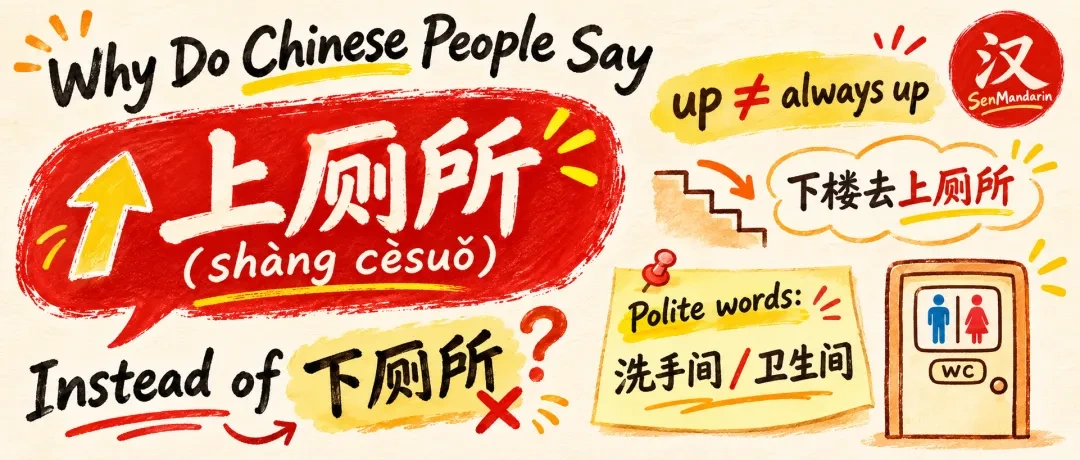
1. What Does 上厕所 Actually Mean?
First, let’s understand the expression.
上厕所 (shàng cèsuǒ) means to go to the toilet or use the restroom.
It’s one of the most common expressions in everyday Chinese.
In terms of grammar, 上厕所 is a verb-object phrase:
-
上 (shàng) – the verb
-
厕所 (cèsuǒ) – the object, meaning toilet or restroom
Together, they form an expression meaning “to use the restroom”.
Examples:
📌 我想上厕所。
I need to use the restroom.
📌 他刚才去上厕所了。
He just went to the restroom.
📌 孩子已经可以自己上厕所了。
The child can use the toilet independently now.
Remember: In modern Chinese, 上厕所 is a familiar, established expression. You should learn it as a complete phrase rather than translating each character separately.
2. Why Do We Use 上 Instead of 下?
The interesting thing is that 上 and 下 don’t always work as direct opposites in Chinese expressions.
Sometimes they describe physical direction. In other expressions, their meanings are part of established word combinations.
Let’s look at some common examples.
When 上 and 下 describe direction:
-
上楼 (shàng lóu) – to go upstairs
-
下楼 (xià lóu) – to go downstairs
-
上车 (shàng chē) – to get on a vehicle
-
下车 (xià chē) – to get off a vehicle
Here, 上 and 下 describe opposite movements.
When 上 and 下 are used in everyday expressions:
-
上班 (shàng bān) – to go to work / start work
-
下班 (xià bān) – to finish work
-
上课 (shàng kè) – to attend or teach a class
-
下课 (xià kè) – for a class to end
Examples:
📌 我每天八点上班,下午五点下班。
I start work at eight every day and finish at five in the afternoon.
📌 我们九点上课,十一点下课。
Our class starts at nine and finishes at eleven.
Notice that 上 and 下 have different functions in different combinations.
You cannot simply replace one with the other whenever you want to create an opposite meaning.

3. Is There a Historical Reason?
Yes! This is probably the most interesting part of the story.
According to a historical linguistic study by Chinese scholar Yu Liming, the use of 上 in 上厕所 can be traced back to the physical action of stepping up onto an old-style latrine structure.
In some historical toilet designs, a wooden platform was placed above a pit to support the person using it.
People had to step onto this structure when using the toilet.
Over time, the expression 上厕 developed into a familiar way of referring to the whole activity.
Later, 厕所 became the common expression for a restroom, giving us the modern phrase:
上厕所 (shàng cèsuǒ).
So, the historical explanation is connected with an actual upward movement!
However, this is a historical explanation based on old written records. It does not mean that all ancient toilets were built this way, or that modern speakers think about climbing up whenever they say 上厕所.
Isn’t language interesting? 😊
4. What If the Toilet Is Downstairs?
Here’s another interesting question.
What if the restroom is actually downstairs?
Do we still say 上厕所?
Yes! Absolutely.
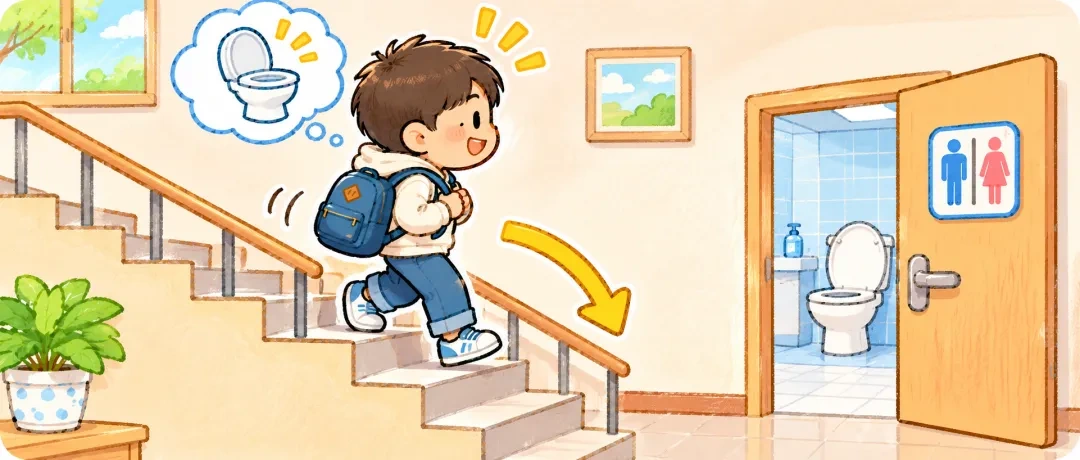
Even if the restroom is downstairs, the expression remains 上厕所.
You simply use 下楼 to describe the direction of movement.
For example:
📌 我下楼去上厕所。
I’m going downstairs to use the restroom.
Look at the two expressions:
-
下楼 – to go downstairs
-
上厕所 – to use the restroom
They describe two different things.
This is why both expressions can appear naturally in the same sentence.
And that’s exactly why translating Chinese word by word can sometimes be confusing!
5. How Can You Say It More Politely?
上厕所 is completely normal in everyday conversation.
However, if you want to sound a little more polite, especially in formal situations, you can use these expressions:
去洗手间 (qù xǐshǒujiān) – to go to the restroom
去卫生间 (qù wèishēngjiān) – to go to the restroom
Both are common alternatives to 厕所.
Examples:
📌 不好意思,我去一下洗手间。
Excuse me, I’ll just go to the restroom.
📌 请问,洗手间在哪里?
Excuse me, where is the restroom?
A useful tip: You can also say 上卫生间 or 上洗手间. These are natural expressions too.

📝 Quick Practice!
Choose the correct answer.
1. 我想 _____ 厕所。
A. 上
B. 下
2. 他每天八点 _____ 班,下午五点 _____ 班。
A. 上 / 下
B. 下 / 上
3. 我们现在在三楼,餐厅在一楼。我们先 _____ 楼,然后去吃饭。
A. 上
B. 下
4. In a polite situation, which expression is more suitable?
A. 去一下洗手间
B. 下厕所
Answers
-
A – 上厕所
-
A – 上班 / 下班
-
B – 下楼
-
A – 去一下洗手间
🎯 Final Tip
Chinese is full of expressions that cannot be understood by translating each character separately.
For example:
-
上厕所 – to use the restroom
-
上班 – to go to work
-
下班 – to finish work
-
上课 – to attend a class
-
下课 – for a class to end
-
上车 – to get on a vehicle
-
下车 – to get off a vehicle
The best way to learn these expressions is to understand their meanings and remember how they are naturally used.
So, next time you need the restroom in China, remember:
上厕所, NOT 下厕所! 🚻
And if someone asks you why, now you have an interesting story to tell!